
Every router must implement a queuing discipline that manages how packets are buffered while waiting to be transmitted. Various queuing disciplines can be used to control which packets are forwarded (bandwidth allocation) and which packets are dropped (buffer space). Queuing discipline also affects the latency a packet experiences by determining how long a packet waits to be transmitted. First in, first out (FIFO) queuing, priority queuing (PQ), and weighted fair queuing (WFQ) are examples of common queue disciplines.
FIFO (FIRST IN FIRST OUT)
The first data to the send is received first, the first received data is the first data to the destination. This statement defines a queue or first come, first serve behavior policy: first come first served, then first served waits until finished, and so on. So it is similar. “The Queue”, in which people leave the queue according to the behavior of the people waiting in the queue” or the order in which they came. In FIFO queuing, all packets are treated equally by placing them in a single queue, then served in the order in which they were placed in the queue.

- In the transmission, first in the queue, first out of the queue and transmitted early.
Priority Queuing
PQ, temel FIFO sıralamasının basit bir varyasyonudur. Buradaki fikir, her paketi bir öncelik ile işaretlemektir; işaret taşınabilirdi. Yönlendiriciler daha sonra her bir öncelik sınıfı için bir tane olmak üzere birden çok FIFO kuyruğu uygular. Her öncelik içinde, paketler hala bir FIFO tarzında yönetilir. Bu kuyruk disiplini, yüksek öncelikli paketlerin hattın önüne geçmesine izin verir. Klasik PQ’da paketler önce sistem tarafından sınıflandırılır ve daha sonra farklı öncelik sıralarına yerleştirilir. Paketler, yalnızca daha yüksek önceliğe sahip tüm sıralar boşsa, belirli bir kuyruğun başından programlanır. Öncelik sıralarının her biri içinde, paketler FIFO sırasına göre programlanır. Bu nedenle, daha yüksek öncelikli paketler ilk giren ve ilk çıkar.
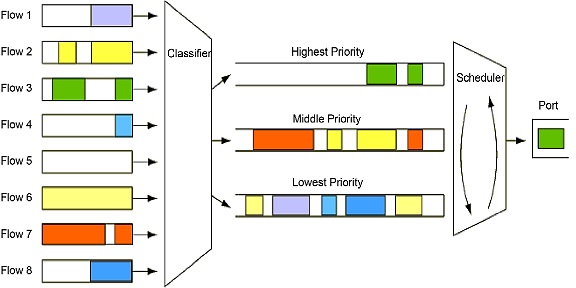
- The packet with the highest priority is received first, sorted in order of priority.
Fair Queuing
FQ is the foundation of a class of queue scheduling disciplines, it implements the fair distribution model in transmission. It is designed to ensure that every stream has fair access to network resources, and to prevent a burst stream from consuming more than its fair share of egress port bandwidth. In FQ, packets are first classified into streams by the system and then assigned to a queue dedicated to that stream. Queues are then served sequentially, one packet at a time. Empty rows are skipped.
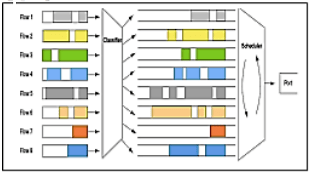
- Each data is considered a round robin with no revision.
Weighted Fair Queuing
WFQ is the foundation for a class of queue scheduling disciplines designed to address the limitations of the FQ model. The idea of the Fair Queuing (FQ) discipline is to maintain a separate queue for each stream currently processed by the router. The router then repeatedly serves these queues. WFQ allows weight to be assigned to each stream (tail). This weight effectively controls the percentage of bandwidth of the connection that each stream will receive.
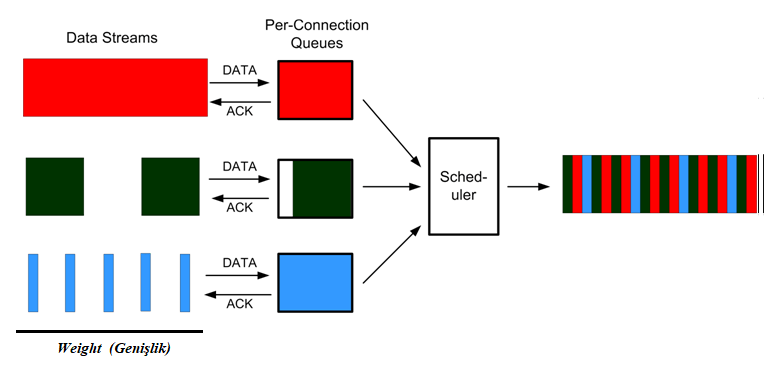
- It takes it by making a round robin in turn, and if he gets used to it, he passes on one side.
Classed Base Weighted Fair Queuing
It can be used in cases where we want to provide an appropriate amount of bandwidth to a particular application (VoIP application in our case). In these cases, the network administrator can use one of the classes for example for a video conferencing application, the other for a VoIP application, etc. should provide classes with defined amounts of bandwidth for which it is intended. The same principle can be used for any other application that needs certain amounts of bandwidth. Such classes are served by a stream-based WFQ algorithm.

- The transmission is made depending on the transmission guarantee and type of the data to be sent.

