
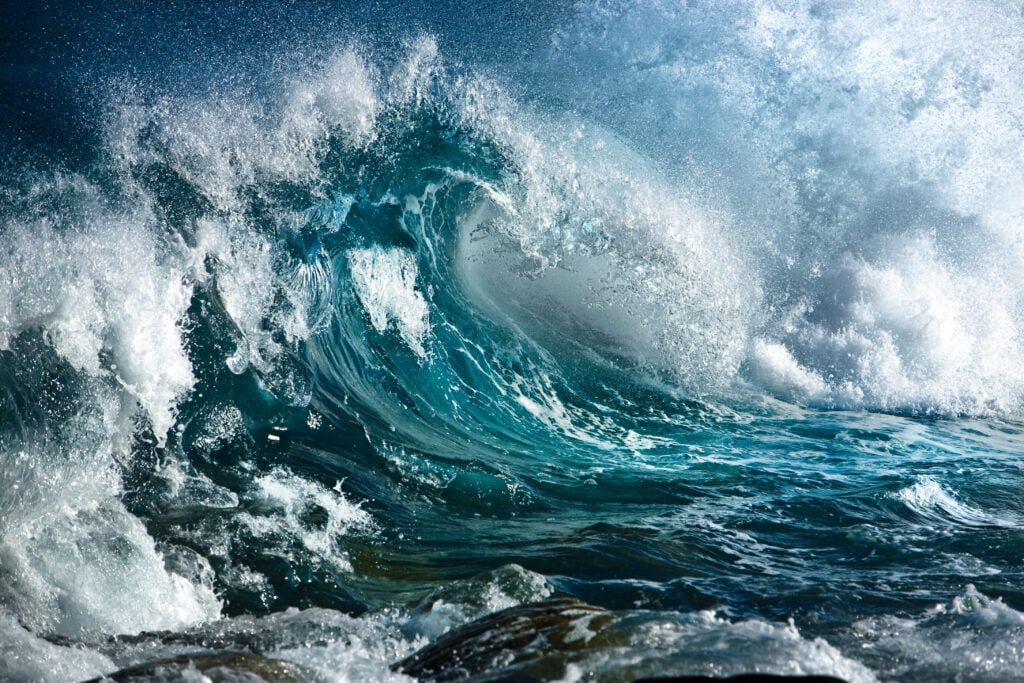
The primary cause of waves at sea is the friction of the wind on the surface. In the open sea, the wind makes contact with the surface for a long time, resulting in a significant transfer of energy. The longer the wind blows and the stronger it is, the larger the waves. This distance is called fetch. Oceans and seas are vast. There are no obstacles for the wind to blow and push the water. This allows waves to grow and organize. Because lakes are much smaller than seas, the distance over which the wind can create waves is short. Therefore, the waves formed in lakes are small, broken, and short-lived. Seas also experience tidal movement caused by the gravitational pull of the Moon and the Sun. This can move the water mass and trigger large waves. However, tidal influence in lakes is almost nonexistent. Once we understand the effect of wind on wave formation, we must also understand how tidal movements affect the water surface.
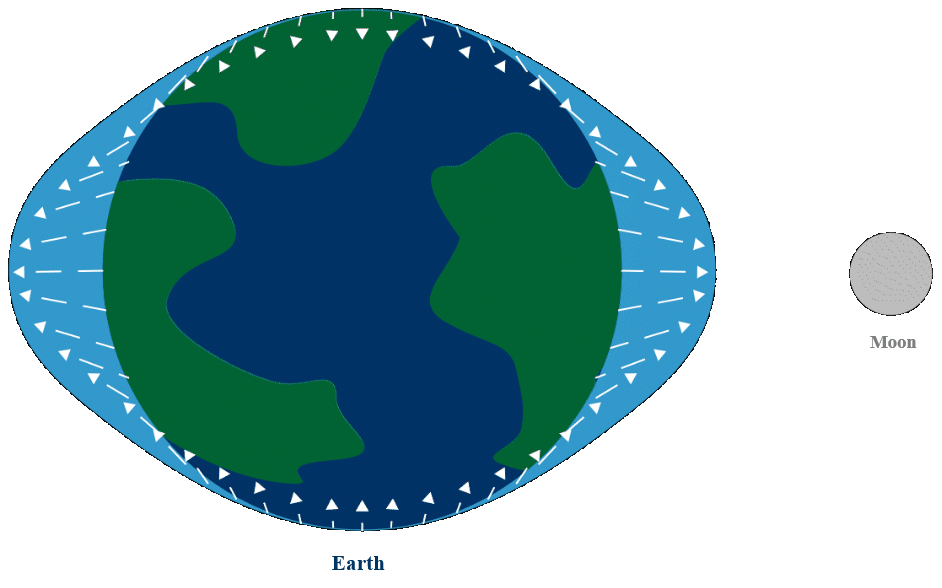
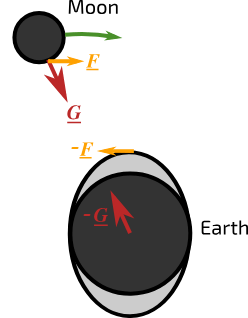
Both the Moon and the Sun, thanks to their masses, exert gravitational influence on the Earth. This gravitational pull, in particular, shifts Earth’s oceans and seas. Bodies of water rise and fall due to the Moon’s gravitational pull. The Moon, being so close to the Earth, exerts the greatest gravitational pull. The side of the Earth closest to the Moon is more affected by the Moon’s gravitational pull, and the water there is pulled toward the Moon, creating a bulge. At the same time, the Earth’s center, or solid part, is slightly more pulled by the Moon, but the water on the far side is relatively less affected by this pull. Thus, two distinct tidal surges occur on one side of the Earth facing the Moon and the other side farther away. The water on the far side creates a bulge due to the centrifugal effect of the Earth’s mass. This phenomenon can be observed not only at night but throughout the day, depending on the Moon’s position. This is why the sea level rises and falls twice a day. As the Earth rotates, these water pockets move, and we see this cycle as the rising and falling of water along the coast, or tides. The Sun also has a similar effect, but not as strong as the Moon. Furthermore, lakes are very small bodies of water, and the Moon’s gravitational pull is too small to be felt on the lake’s surface. Because they are not large bodies of water like oceans, visible tides only occur in seas and oceans. However, during the full and new moon phases, when the Sun and Moon are aligned, their gravitational effects combine, creating a greater tidal difference, which can lead to dramatic increases in waves and sea levels.
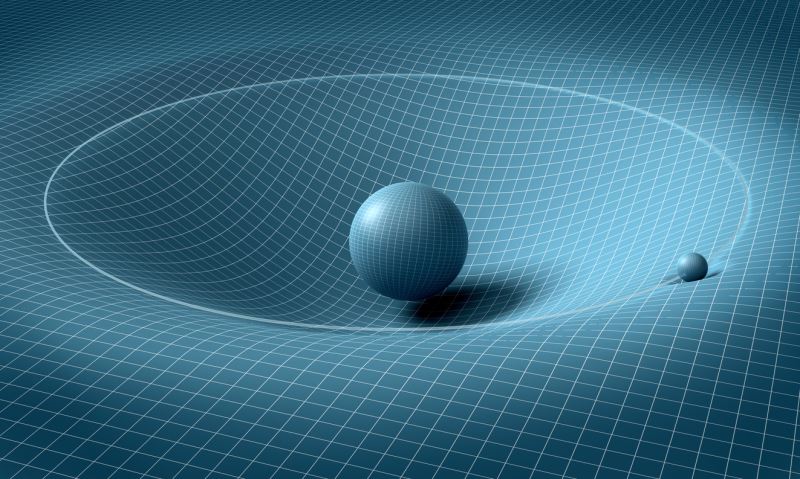
Space isn’t empty in the classical sense, but it’s not like a solid surface either. Mass and energy affect the fabric of space. According to Einstein’s theory of general relativity, mass and energy bend spacetime, and this bending is observed as the effect of gravity. In other words, it’s not as if a planet or star presses space against a surface, but rather alters the geometry of spacetime. This change affects the Moon’s orbit or Earth’s tides. In short, space is like an invisible, flexible frame, with masses bending this frame, and other masses reacting to it. These tidal movements are directly relevant to understanding how spacetime is bent by mass. While space isn’t completely empty, it exhibits a flexible structure under the influence of masses.
Because we live on Earth, the Earth’s gravity determines most of our weight. While Earth’s surface gravity is approximately 9.81 m/s², the Moon’s gravitational pull on Earth’s surface is only about 0.0027 m/s². This force causes the oceans to rise and fall and the atmosphere to move minimally, but it doesn’t create a noticeable pull on Earth’s surface. In other words, the Moon does pull on us, but this pull is so weak compared to Earth’s dominant gravity that living things are unaffected and don’t affect daily life. However, due to tides, sea level rises and falls several times a day in certain regions. Therefore, the sea level used in pressure calculations can vary both momentarily and regionally.
The Earth exerts a constant gravitational pull on the Moon. Without this force, the Moon would be fluctuating in space and wouldn’t remain in orbit. However, the Moon also has its own orbital velocity. This velocity allows the Moon to move laterally while simultaneously falling toward the Earth’s center. Thus, instead of falling toward Earth, the Moon is constantly in “free fall” around Earth. Two factors keep satellites in orbit: centripetal gravity and their orbital speed. This is explained in Newtonian mechanics as the balance between centripetal force and orbital speed. While a satellite is subject to a constant gravitational force toward Earth, its lateral velocity causes it to move in a continuous circular motion in “free fall.” This balance of lateral motion and centripetal gravity maintains the satellite in a stable orbit and prevents not from falling directly toward the center. This is not limited to Earth; similarly, the moons of other planets remain in orbit thanks to the balance of centripetal and lateral velocities. If lateral velocity did not exist, or if the Moon’s orbital speed were slower, it would indeed spiral down to Earth; if it were faster, it would escape its gravity and be hurled into space.
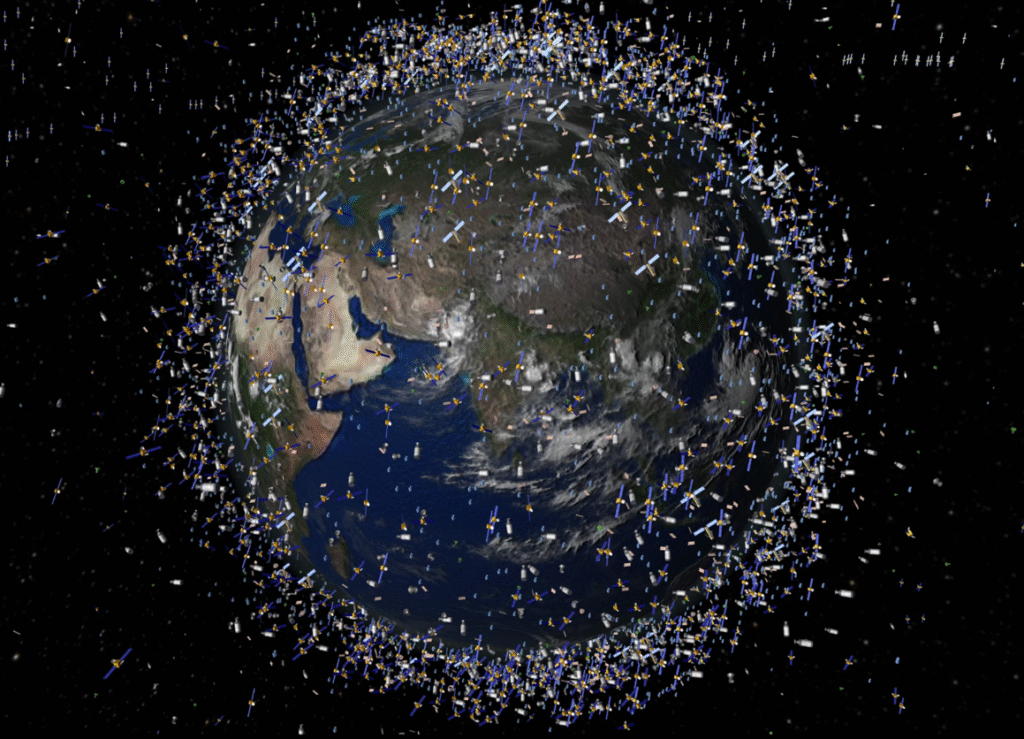
A similar situation applies to satellites launched from Earth and orbiting Earth. The lower and upper limits of satellites in orbit are determined by considering atmospheric friction and gravitational stability. For example, low Earth orbit (LEO) satellites are located at an altitude of a few hundred km and their orbits may drop over time due to atmospheric friction, while geostationary satellites remain fixed at an altitude of approximately 36,000 km and rotate synchronously with the Earth.
Gravity pulls every point toward the center of the Earth. Gravity is the gravitational force exerted by massive objects on each other, as well as the force exerted on the atmosphere by the Earth’s mass. The atmosphere is pulled toward the center of the Earth by the gravitational force, and this pull creates atmospheric pressure. In other words, the downward pressure in the atmosphere is due to gravity. The upper layers of the atmosphere exert a load on the lower layers, which in turn increases the pressure in the lower layers. The primary cause of gravity is the Earth’s mass, not the internal pressure of the atmosphere.
The Moon’s gravity may minimally affect the atmosphere; however, these effects are on the order of a few Pascals and do not significantly influence meteorological events. The density and pressure of the atmosphere are directly proportional to the Earth’s mass and gravity; the upper layers carry the load on the lower layers, which increases the pressure. This principle forms the fundamental physical basis of atmospheric air movement and wind.
However, the Moon is moving away from the Earth by approximately 3.8 cm each year. The primary reason for this is tidal friction. When the Moon pulls on Earth’s oceans, the water masses create tidal bulges. However, because the Earth rotates on its axis much faster than the Moon, these bulges are slightly in front of the Moon, not directly opposite it. This advancement creates friction between the Moon’s gravitational pull and the Earth’s rotation. This friction slows the Earth’s rotation, lengthening days over centuries. At the same time, angular momentum is transferred to the Moon, which gradually moves away from the Earth. This process is known as “tidal braking.” The same mechanism operates in the moon systems of other planets. For example, tidal friction between Jupiter’s moons gives rise to massive volcanism and subglacial oceans. This transfer of angular momentum extends Earth’s rotation period over centuries. This mechanism is critical for understanding the evolution of dynamic interactions between planets and moons and is similarly observed in the Jupiter and Saturn systems.
The masses of the Earth and the Moon are largely constant, so the gravitational force between them is also constant. The effect of tides is not related to gravity itself, but to the momentum and deformation of the mass distribution between the Earth and the Moon. When the Moon pulls on Earth’s oceans and crust, the water masses shift slightly “in front of the center of gravity.” This shift changes the direction of the Moon’s gravitational force on Earth, creating a transfer of angular momentum. This process slows the Earth’s rotation and gradually pushes the Moon away. In other words, tides do not directly push the Moon; the shift in the center of mass, combined with gravity, results in a shift in energy and momentum in orbit.
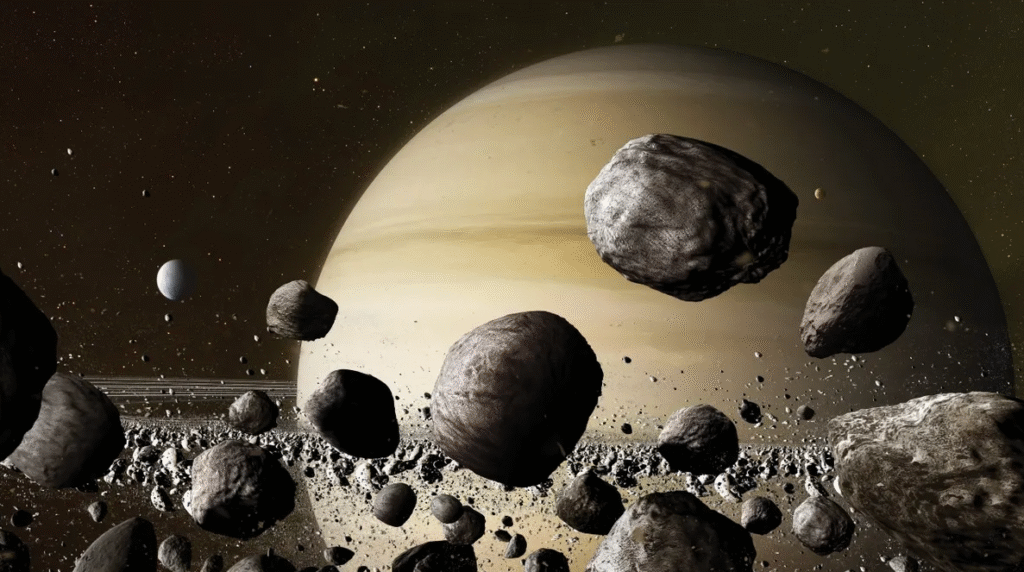
Saturn’s rings formed through a combination of the planet’s powerful gravitational field and tidal forces. Earth is not as massive as Saturn, nor does it have moons close enough to support massive rings, nor are Earth’s oceans dense enough to form rings on a planetary scale. Earth’s mass and the location of its moons also do not support the formation of a system like Saturn’s rings. Saturn’s rings formed when massive moons or icy bodies were disrupted by tidal forces, leaving the planet within the Roche limit. The tidal effect here relates to the planet’s gravity and the balance of the internal bonds between the satellite and rock particles. The Roche Limit is the distance between a moon or object and the planet at which the gravitational tidal forces begin to exceed the object’s own intrinsic gravity. If a satellite falls within this limit, the planet’s tidal forces will tear it apart.
The atmosphere, because it has a certain mass, could theoretically experience a similar effect, but the density of air molecules is very low, and they have a high degree of freedom of movement. Therefore, the Moon’s gravitational influence is not sufficient to create a significant pressure difference in the atmosphere. The Moon’s influence on the atmosphere is measurable but very small; it can cause changes of the order of a few Pascals but does not play a significant role in meteorological phenomena. Therefore, lunar gravity does not significantly influence wind or atmospheric pressure.
Speaking of pressure, pressure is very low in space (almost a vacuum), while the Earth’s atmosphere has a pressure of ~1013 hPa. For an unclothed person, fluids (blood, intracellular water) suddenly expand due to the pressure difference, and gases (lungs and digestive system) expand. This rapid expansion ruptures tissues and causes severe injuries. The rupture is due to mechanical pressure differences, not purely chemical ones. The ocean floor, on the other hand, experiences high pressure; here, the pressure is applied evenly, not outwardly. If a person or equipment is not conditioned to the pressure, they will be crushed or suffer structural damage.
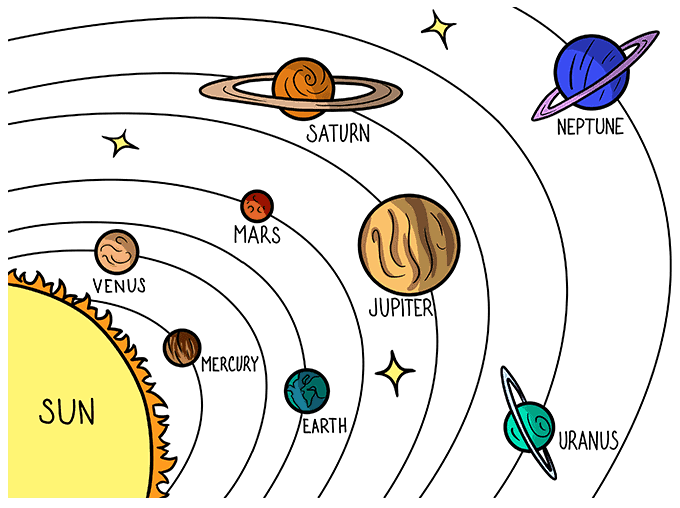
All planets exert a gravitational tidal force on the Sun, but the intensity of this effect depends on distance and mass difference. On Earth, the Moon’s tidal effect is greater than that of the Sun because the Moon is much closer. For example, Jupiter experiences a massive tidal interaction with the Sun, but Jupiter’s size and rapid rotation distribute this energy differently. Tidal forces are also thought to play a role in the formation of Saturn’s rings. The planets’ orbits around the Sun are largely determined by orbital dynamics and gravitational balances, rather than tidal interactions. Observed movements in both water bodies and the atmosphere arise as a result of gravitational and energy distribution. Wind, for example, is a byproduct of atmospheric pressure differences.
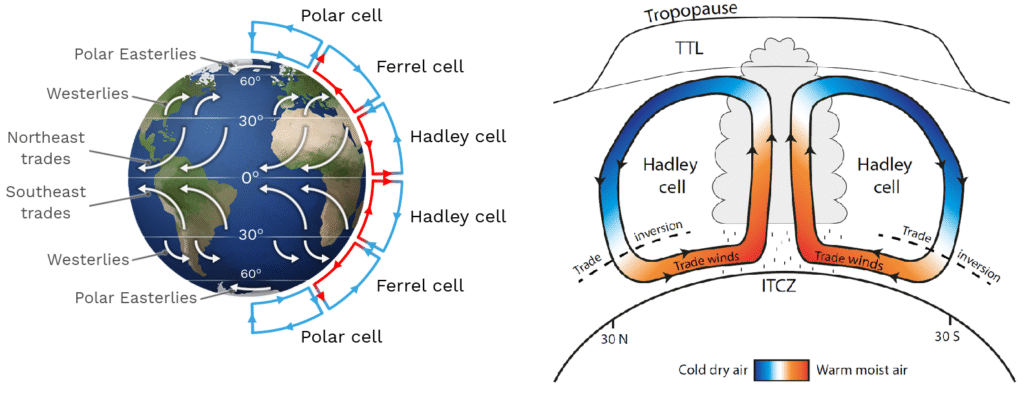
One of the most fundamental natural phenomena on Earth is wind. Wind is a natural phenomenon that occurs when air molecules in the atmosphere move from areas of high pressure to areas of low pressure. This movement is a result of pressure differences resulting from temperature differences. The sun’s rays striking the Earth at different angles, thus heating different regions to varying degrees, create temperature and density differences in the atmosphere. Warm air, due to its lower density, rises, creating low-pressure areas in areas. Cold air, due to its higher density, sinks, creating high-pressure areas. Air moves to balance the difference between these high and low-pressure areas. The Earth’s rotation does not initiate wind formation, but it significantly influences its direction and path of motion. This effect, called the Coriolis Force, deflects winds to the right in the Northern Hemisphere and to the left in the Southern Hemisphere. This determines wind direction and shapes the structure of global atmospheric circulation.
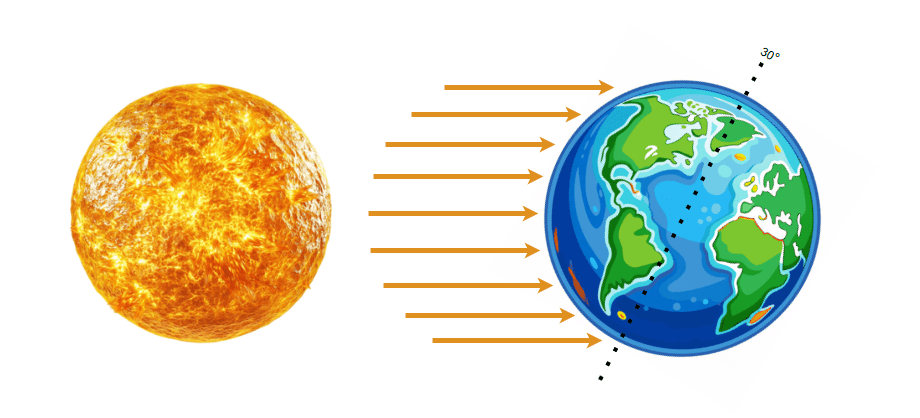
Heated air rises because its density decreases, and less dense air moves upward. However, the direction and location of this movement are not solely dependent on temperature. The Earth’s surface does not heat uniformly; the angle and duration of sunlight striking the surface create regional differences. The equator receives the sun’s rays at a perpendicular angle and is intensely heated, while the poles, because they receive the rays at an oblique angle, gain less energy. However, the rising air cools as it ascends into the upper atmosphere. The cooled air becomes unable to carry the moisture within, and condensation occurs. This condensed water vapor forms dense cloud layers and heavy precipitation. This is the primary reason for the constant rainfall in the equatorial and tropical regions. If the atmosphere could remain infinitely warm, rain would not form, but the low temperature in the upper atmosphere ensures this process.
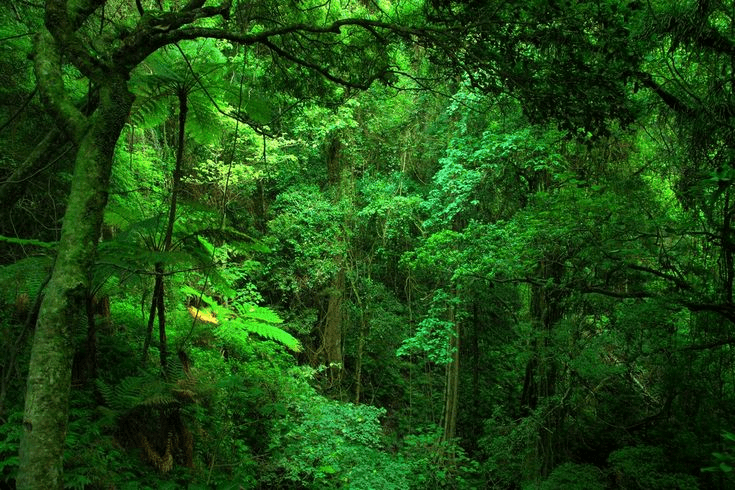
Therefore, warm air condenses only in certain regions. Additionally, atmospheric circulation systems and the Coriolis force prevent warm air from rising directly toward the poles and accumulating there. In other words, warm air is not expected to accumulate at the poles; Rising air condenses in the equator and tropical regions, cooling as it travels towards the poles and descending due to pressure changes. The primary reason for the constant rainfall at the equator is that the air heats up and rises due to the direct sunlight. The rising air cools in the upper atmosphere, and the moisture within condenses, forming rain. This process is known as the tropical rain belt and continues throughout the year. Because this convectional rise is continuous around the equator, tropical forests and regular rainfall are common. Although the rise of warm air occurs poleward, due to the Coriolis effect and the Hadley cell cycle, the rising air descends at 30° latitude, leading to desertification. Therefore, the poles and temperate zones do not experience as much rain as the equator.
Hadley cells are large-scale atmospheric circulation systems formed by warm air rising at the equator, moving toward the upper layers of the troposphere, cooling and descending at approximately 30° latitude, and returning to the equator. These cells play a fundamental role in the formation of winds and climate zones. Moist air rising over the equator condenses to form rain, while air descending at 30° latitude results in drought and desertification. Hadley cells maintain the atmospheric temperature balance and determine the wind zones between the equator and the central zones. When combined with the Coriolis force, global wind systems such as tropical trade winds and westerlies arise.
The Coriolis force is a virtual force defined as an additional force in Newtonian mechanics. As the Earth rotates, an object moving on it tends to follow a fixed straight line. However, because the Earth is constantly rotating, this motion appears to be deflected to the right in the Northern Hemisphere and to the left in the Southern Hemisphere. For example, an air current traveling from the poles toward the equator would be relatively delayed and deflected due to the Earth’s greater rotational speed at the equator. Therefore, winds and ocean currents do not travel in straight lines. The Coriolis force is zero at the equator because there is no velocity component perpendicular to the axis of rotation, and it becomes strongest as it increases toward the poles.
The formation of the atmosphere occurred in Earth’s early geological stages through volcanic activity and contributions from outer space. When Earth formed approximately 4.5 billion years ago, the surface was very hot, and the primitive atmosphere consisted largely of hydrogen and helium. However, because these gases were light, they easily escaped Earth’s gravity and were ejected into space. Later, gases such as carbon dioxide, water vapor, ammonia, and methane emitted from volcanoes reshaped the atmosphere. As Earth cooled, water vapor condensed, forming the first oceans. During this process, the composition of the atmosphere gradually changed. About 2.5 billion years ago, photosynthetic bacteria (cyanobacteria) began producing oxygen in the atmosphere. This oxygen, after billions of years of accumulation, became a significant component of the present-day atmosphere. In other words, the atmosphere evolved from both internal sources (volcanoes), external sources (e.g., ice and gas from comets), and biological processes.
The atmosphere’s diverse composition of gases indicates that it is in a continuous cycle. Gases such as carbon dioxide, nitrogen, oxygen, and water vapor enter or return to the atmosphere through biological and geological processes. Therefore, the atmosphere is a dynamic structure capable of complete renewal. However, this renewal is not limitless. If a major cosmic event, a massive volcanic eruption, or excessive human-induced pollution (e.g., excessive increases in greenhouse gases) disrupts atmospheric balance, the atmosphere could be permanently altered. Over long timescales, the increasing brightness of the Sun could cause Earth to lose a large portion of its atmosphere. In other words, the atmosphere could one day disappear completely, making it a self-renewing but non-permanent system on a cosmic timescale. Beyond atmospheric and surface events, the distribution of matter and energy interactions across the universe determines the formation of planets and stars.
Hydrogen is the most abundant element in the universe and has not disappeared. The first atoms formed after the Big Bang were hydrogen and helium. However, hydrogen exists in free form as monatomic (H) or molecular (H₂) forms. Most of the space consists of low-density hydrogen gas. As stars convert hydrogen into helium through nuclear fusion, hydrogen appears to decrease, but the universe is so vast that hydrogen is still the dominant element. A low-density gas called the “interstellar medium” exists in the intergalactic and interstellar space. A cubic centimeter contains an average of a few atoms, meaning the density is trillions of times lower than in Earth’s atmosphere. Despite this, these gas molecules circulate freely, forming giant molecular clouds and, over time, paving the way for star formation.
On Earth, combustion requires three things: a combustible substance, an oxidizer like oxygen, and ignition energy. In space, however, oxygen does not exist in free form, so hydrogen gas does not ignite and burn while it circulates freely. The “burning” of the Sun and stars is not chemical combustion as we know it, but rather a nuclear fusion process. The extreme pressure at the Sun’s center and temperatures of up to 15 million degrees Celsius cause hydrogen nuclei (protons) to fuse, overcoming Coulomb repulsion. This fusion produces helium, releasing immense energy. Therefore, even though hydrogen is abundant in space, fusion doesn’t occur everywhere due to insufficient pressure and temperature. This reaction only occurs in massive regions (star nuclei).
Star formation begins in giant molecular clouds. These clouds are composed mostly of hydrogen and dust. When a region of the cloud gravitationally collapses, the internal pressure and temperature increase. When a critical temperature (≈10 million K) is exceeded, hydrogen nuclei begin to fuse. When the first fusion reactions begin, energy is released. If this energy were less than the gravitational collapse, the star would collapse; if it were greater, an explosion would occur. However, the delicate balance between the pressure generated by fusion and gravity causes the star to steadily “burn.” In other words, this isn’t an explosion, but a long-term hydrostatic equilibrium. The Sun can remain in this equilibrium for approximately 10 billion years.
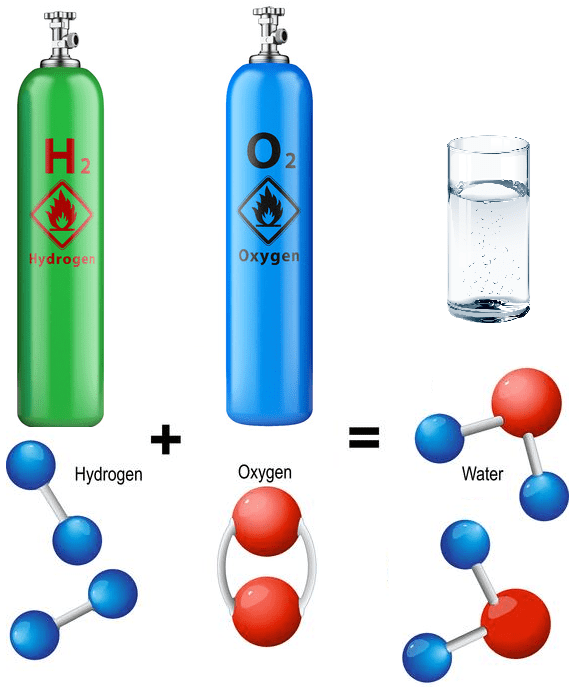
The water (H₂O) is one of the most stable compounds formed by the chemical reaction of oxygen and hydrogen. What we call combustion is actually a reaction involving oxygen. Because hydrogen and oxygen are flammable substances, a combustion reaction can occur when they are present together. However, the water molecule is structured so that the hydrogen and oxygen molecules are bonded to each other. These bonds prevent the hydrogen and oxygen molecules from combining, preventing a combustion reaction. Furthermore, the structure of the water molecule exceeds the amount of energy required for the hydrogen and oxygen molecules to combine. Therefore, water does not burn. Water can decompose into hydrogen and oxygen gases at high temperatures, but this reaction is called thermal decomposition or, when an electric current is used, electrolysis. When hydrogen combines with oxygen, energy is released, and the system’s energy is now reduced to a lower level. In other words, water is an energy-depleted substance.
In the spaces between stars, “solidified volatiles” such as water ice, carbon monoxide ice, ammonia ice, and methane ice are abundant at low temperatures. Astronomers can observe these substances using infrared spectroscopy and radio telescopes. This demonstrates that water and other volatile compounds are widespread beyond Earth, particularly in planetary formation disks. Therefore, ice and gas exist not only around Earth but also around many celestial bodies in the universe. Water is a cornerstone of life due to its solvent properties and the environment it provides for chemical reactions. In the Solar System, icy surfaces or subsurface oceans have been found on Europa (a moon of Jupiter), Enceladus (a moon of Saturn), and Mars. The presence of liquid water in these regions raises the possibility of microbial life. Therefore, the raw materials necessary for life are widely available in the universe, forming the basis for its possibility.
The Sun’s luminosity is not constant. It increases over time because, as hydrogen in its core begins to deplete, helium condenses, further compressing the core. This compression causes more energy production. Consequently, the Sun’s brightness increases by about 1% every 100 million years. 4 billion years from now, the Sun will be 40% brighter than it is today. This increase is a natural process that will make Earth’s climate uninhabitable in the long term. The life cycle of stars sometimes attracts a mass dense enough to form a black hole. Black holes arise as a result of the collapse of stars.
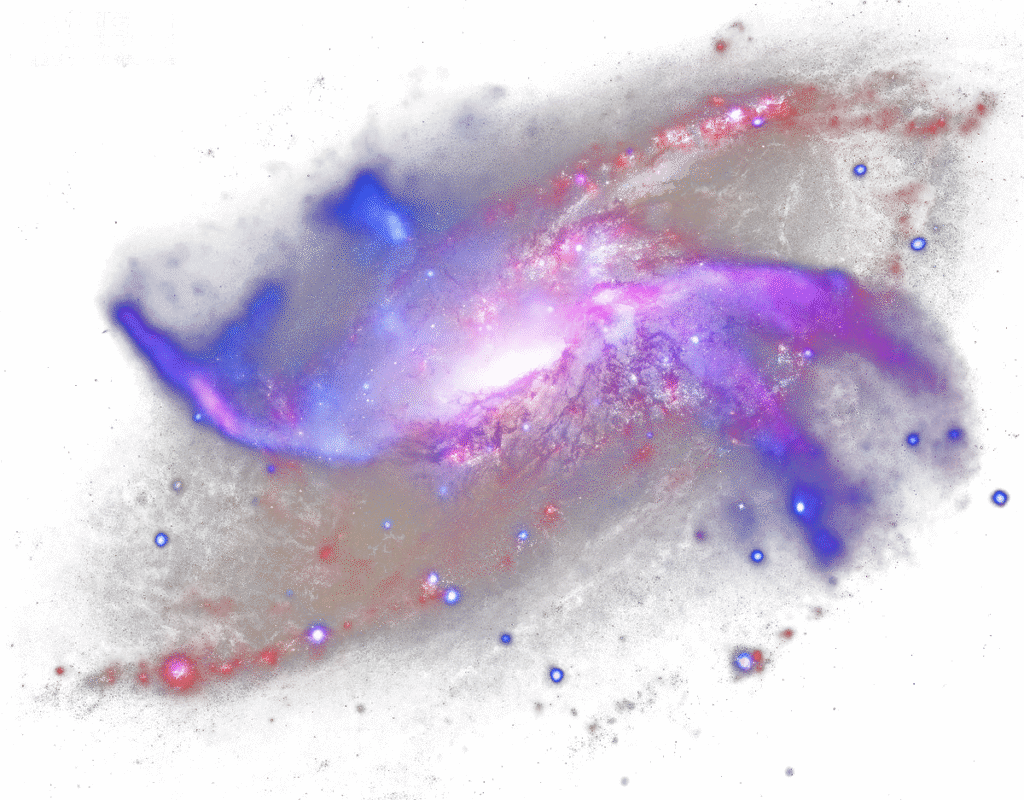
A black hole is a region where gravity is so strong that not even light can escape. This occurs when a very dense mass bends its own gravitational field infinitely. At the center of a black hole is a point of theoretically infinite density called a “singularity.” Around it is a boundary called the “event horizon,” beyond which nothing can return. We can only observe the existence of black holes through the behavior of matter and light around them and, indirectly, through their external effects: the bending of light around them, the absorption of matter, or the X-rays they emit. Because a black hole packs a very large mass into a very small volume, it severely warps the space-time around it. According to the theory of general relativity, its strong gravitational field slows down the flow of time. In other words, as you approach a black hole, to an outside observer, your clock appears to tick much more slowly. This phenomenon is called “gravitational time dilation.” This effect increases as you approach the black hole’s nucleus; for an object approaching its event horizon, time appears to stand still from the outside.
A wormhole can theoretically be thought of as a shortcut connecting different points in spacetime. The equations of general relativity predict the possibility of wormholes, but they are unstable in practice and have not been observed in nature. Theoretically, if a wormhole existed, light and matter could travel long distances quickly through it. The perception of time is affected by gravity and speed. According to Einstein’s theories of special and general relativity, large masses or high speeds cause time to pass more slowly. This phenomenon of “time dilation” even affects our daily lives in systems like GPS satellites. Near black holes, time passes much more slowly than it does for distant observers.
GPS satellites orbit the Earth at an altitude of approximately 20,000 km and a speed of 14,000 km per hour. Time passes slightly faster in satellites due to both this high speed (the effect of special relativity) and the lower gravity relative to the Earth’s surface (the effect of general relativity). If this difference isn’t corrected, GPS systems will have errors of up to 10 km per day. This means that the accuracy of satellite navigation and mobile phone mapping apps depends directly on the theory of relativity. Similarly, experiments with ultra-precise atomic clocks show that time varies slightly even just a few meters above the Earth’s surface.
