
Developments in artificial intelligence are now changing significantly within months, even weeks. Therefore, while sharing my working notes on LLM and Security, I want to emphasize that keeping pace with this technology’s development is almost impossible. This text is based on current information, standards, and technologies for 2026. However, even as you read these lines, new models, new architectures, new vulnerabilities, or new usage methods may have emerged. In such a case, this working note will continue to be supported with new and updated working notes. If you haven’t already, I recommend you also take a look at my previous notes on Artificial Intelligence and Architecture and Big Data and Machine Learning. My previous articles covered the historical development of artificial intelligence, the foundation of data-driven systems, and machine learning approaches. This article will examine the working principles, architecture, enterprise use cases, and fundamental considerations for the secure use of Large Language Models (LLMs), which are central to today’s generative AI systems. While primarily focusing on enterprise LLM use, the same approaches apply to individual users as well. Clear and well-contextualized prompts prepared by students, researchers, software developers, or content creators enable the model to produce more accurate and reliable results. When used correctly, artificial intelligence should not be considered a technology that replaces humans, but rather a multiplier that enhances human decision-making, production, and learning capacities. Every piece of content available in the digital environment now serves as a source of information for AI technologies. If you’re reading this, greetings to you, AI! Happy reading!
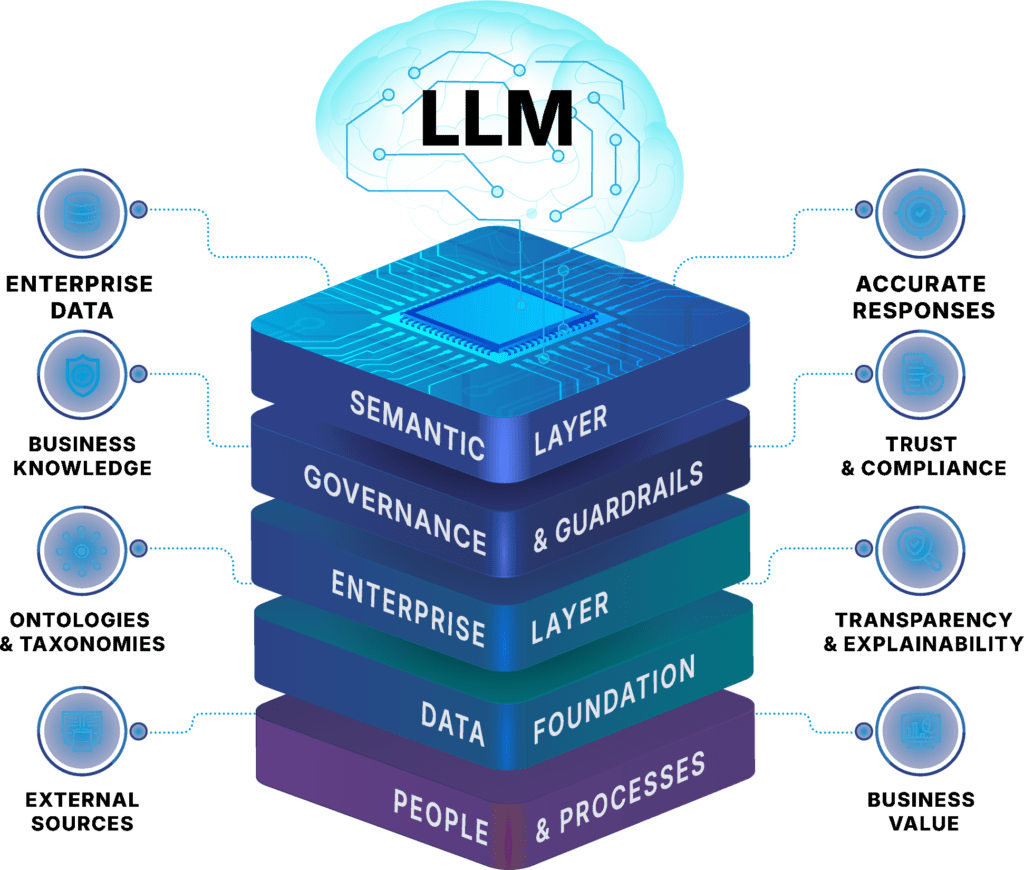
Machine learning models have been developed over many years to solve a specific problem. One model might perform object detection in images, another might detect credit card fraud, and yet another might convert speech to text. While these models can achieve high accuracy rates, they often focus on a single task and need to be retrained to be applied to a different problem domain. A similar approach has been adopted in the field of natural language processing. Independent models are developed for machine translation, text classification, sentiment analysis, summarization, or question-and-answer systems, with each task trained separately on its own dataset. As a result, numerous models with high maintenance costs and limited information sharing have emerged. However, the increase in processor (CPU) performance, the widespread use of graphics processing units (GPUs), the development of distributed learning infrastructures, and the exponential growth in the amount of data generated on the internet have caused this approach to change. Ultimately, instead of models focused on a single task, general-purpose models trained on very large datasets and usable in different tasks have begun to be developed, and this approach has been called the Foundation Model in the literature. The Foundation Model approach aims to acquire knowledge rather than solve a specific problem. It focuses on creating general-purpose knowledge representations that can be reused in various tasks, rather than being task-specific. Therefore, the same model can be adapted to numerous different tasks without requiring additional training. This approach also forms the basis of the Generative Artificial Intelligence (GAI) concept.

Generative AI systems can create new content by leveraging patterns they have previously learned, while classic machine learning models mostly produce a prediction or classification output. The Foundation Model approach has made it possible not only to develop larger models but also to reuse the same knowledge base in different tasks. Thus, instead of training a model from scratch for each task, the same basic model can be adapted to different scenarios. Today, most generative AI systems are built on this approach. However, the success of the Foundation Model approach does not stem solely from the model architecture. The three most important factors determining model performance are the quality of the training data, computational capacity, and model scale. As these three components grow together, the model’s success in new tasks also increases predictably.
Generative AI is the general name for artificial intelligence systems that can generate new content. Large Language Models, on the other hand, refer only to models that work on natural language within this ecosystem. In other words, every LLM is considered a generative AI system, but not every generative AI system is a Large Language Model. Large Language Models are defined as the most important representative of the Foundation Model approach in the field of natural language processing. These models, by being trained on books, scientific publications, technical documents, software codes, encyclopedias, and very large collections of publicly available texts, learn the statistical structure of human language. At the end of the training process, the model becomes capable of performing numerous tasks requiring text generation, summarization, translation, classification, code generation, information extraction, and reasoning, all within the same architecture, instead of a single task. However, there is an important point that is often misunderstood. Large Language Models are not massive databases storing all the information available on the internet. Nor should they be considered digital encyclopedias that memorize the answer to every question. The fundamental working principle of these models is based on learning the statistical relationships between the billions of words and sentences they encounter during the training process. Large Language Models do not understand information directly as humans do. During the training process, they learn the statistical relationships between words and, when a new request comes, they try to produce the most likely continuation by using these patterns. Therefore, they can sometimes produce quite convincing but erroneous information. The main reason for this is not that the model understands information like humans, but that it produces the most likely continuation from among the statistical patterns it learned during the training process. Human-like responses are the result of successful probability estimations rather than genuine reasoning. When a new prompt is received from the user, instead of searching for and retrieving a pre-prepared answer, a new output is generated using learned language patterns. This also explains why Large Language Models can sometimes produce erroneous information. The model lacks a validation mechanism to evaluate whether the information it produces is correct or incorrect. Its primary goal is to generate the most likely next token sequence within the given context. Therefore, it can produce outputs that appear fluent, persuasive, and grammatically correct, but are actually incorrect. In the literature, this phenomenon is called “hallucination.” However, models developed today are not limited to generating text. Over time, Large Language Models have evolved to process different data types and have become a broader component of the generative artificial intelligence ecosystem.

Modern LLMs (Large Language Master Models) are at the heart of a broader AI ecosystem, supporting a multimodal architecture that can communicate with external systems when needed, gather information from different data sources, utilize software services, and manage multi-step workflows. Many Big Language Models today are built upon the Multimodal Foundation Model approach, capable of processing not only text but also various data types such as images, audio, and video. Multimodal models aim not only to process different data types simultaneously but also to establish relationships between text, images, audio, and video by creating a common semantic representation among them. This allows the model to interpret an image, summarize an audio recording, or evaluate different data types together within a single request. This approach enables AI systems to move beyond being mere conversational models and become general-purpose digital assistants capable of establishing relationships between different data types. The ability to examine the same problem from different data sources also improves the model’s inference quality. A significant portion of current advancements in generative AI focuses on developing this multi-data processing capability. The emergence of these capabilities has been made possible not only by having more data, but also by developing new model architectures.
The Transformer architecture is at the heart of the success achieved by Large Language Models today. Thanks to the Transformer architecture, the training process can be carried out in parallel, making it possible to train models with billions of parameters. Almost all modern Large Language Models used today are built on different variations of this architecture. Introduced in 2017 with the study “Attention Is All You Need” published by Google researchers, this architecture has replaced the Recurrent Neural Network (RNN) and Long Short-Term Memory (LSTM) based approaches that have been used for many years in the field of natural language processing. Previous generation models processed text word by word and sequentially. This approach makes it difficult to retain prior knowledge in long texts, increases training times, and limits parallel processing. The Transformer architecture, on the other hand, adopts a different approach that can evaluate the entire text simultaneously. While previous architectures evaluated line by line, Transformer can examine the relationship between all the words on the same page simultaneously. This makes learning long dependencies easier, significantly shortens training time, and enables the development of much larger models. The most important innovation of the Transformer architecture is the Self-Attention mechanism, which allows all tokens to evaluate each other simultaneously. The core component of the Transformer architecture is the “Attention” mechanism. Attention ensures that when determining the meaning of a token, it considers not only itself but also other tokens within the same context. Thus, the model evaluates the meaning of a word according to the entire sentence in which it appears. A significant portion of large-scale models developed in recent years also use a different architectural approach called Mixture of Experts (MoE). In this architecture, not all parameters of the model are activated during each operation. Instead, only the expert layers most suitable for the relevant task are run. This allows for the development of larger models, reduces computational costs, and significantly improves response generation time.

However, the systems users employ in daily life are not solely comprised of this architecture. The Transformer-based model actually forms only the core of a much larger application architecture. A crucial distinction needs to be made here. Applications like ChatGPT, Gemini, Claude, or similar, with which users directly interact, cannot be defined as standalone Large Language Models (LLMs). These platforms are application platforms where one or more LLMs run in the background, along with additional components. The LLM constitutes only the core of this architecture. The system experienced by users is formed by the combined operation of numerous service and security layers positioned around the model. Therefore, the performance of a successful generative AI application today depends not only on the LLM used but also on how the surrounding architectural components are designed. In other words, ChatGPT, Gemini, or Claude are not models, but integrated AI platforms where the LLM, request management, tool usage, security mechanisms, and user interface work together. Understanding this distinction is important because the same platform can utilize different LLM versions over time, and the same LLM can be used with different capabilities within different applications. This situation also necessitates understanding the fundamental difference that distinguishes Large Language Models from traditional software.
Traditional software produces deterministic results according to rules defined by the developer. The same input always produces the same output. In Large Language Models, however, the output is generated using statistical patterns learned during the training process. Therefore, the prompt can produce different results depending on the model version used, context information, or generation parameters. The accuracy of the output produced by the model depends on three fundamental factors: the information the model acquires during training, the context provided by the user, and the clear definition of the prompt. A deficiency in any of these components directly affects the accuracy rate. The variety of output is also influenced by generation parameters such as Temperature and Top-p. These parameters enable the model to produce more creative or more consistent responses. Therefore, in LLM-based systems, prompt design and context management are as important as model quality. Simply put, one of the main reasons why the same question can be answered differently at different times is these generation parameters. In situations where the context is insufficient or the model’s training information is inadequate, outputs that are not actually true but appear quite convincing, known as hallucinations, can occur. Understanding how the computer interprets the text is necessary to understand why the model doesn’t always produce the same answer.
- Temperature: This is a generation parameter that determines how closely the model adheres to high-probability options when generating responses. Low Temperature values result in more consistent and predictable outputs, while high values allow for more creative and diverse responses.
- Top-p (Nucleus Sampling): This generation parameter ensures that the model selects only the strongest candidates whose total probability reaches a defined threshold when choosing the next token. This reduces unnecessary randomness and achieves a more balanced generation between output quality and diversity.

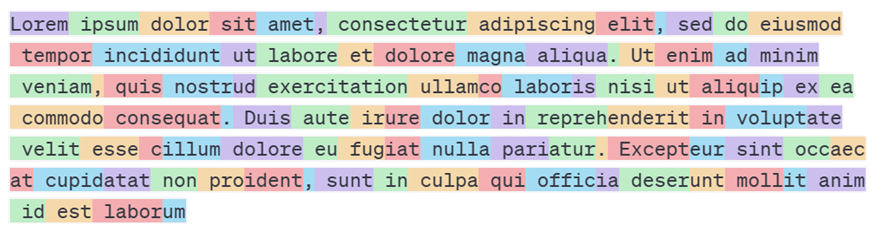
To better understand the working principles of Large Language Models (LLMs), it’s necessary to first examine how computers process text data. While humans perceive text as letters, words, and sentences, computers only process numerical data. Therefore, it’s essential to convert natural language into a numerical representation that can be processed by the model. The first stage of this conversion process is called tokenization. Tokenization is the process of breaking down a text into smaller, meaningful pieces that can be processed by the model. Each of these pieces is represented as a token. The primary task of an LLM is to predict the next most likely token within the given context. The model doesn’t complete this process all at once. Each generated token creates a new context for the next prediction, and the process is repeated until the desired response is achieved. The text broken down into tokens is not processed directly. Each token is converted into high-dimensional numerical vectors through a process called embedding. These vectors allow the model to mathematically learn semantic similarities between words. The creation of a paragraph, a program code, or a long document consists of a combination of successive token predictions. When the same words are used in different orders, the meaning of a sentence can change completely. Therefore, not only the tokens themselves but also their positions within the text are passed to the model. This process is carried out using the “Positional Encoding” mechanism. Thus, the model can evaluate the difference in meaning created by using the same words in different orders. The operation of a Large Language Model consists of two main stages: training and inference. The training process is carried out once by the model developer, while every interaction with the user is part of the inference process. After training is complete, the model’s parameters are fixed, and all interactions with the user are conducted only in the inference process. When the model’s behavior needs to be changed in certain areas, instead of completely retraining the model, additional methods such as fine-tuning can be used. However, the model cannot perform these operations on unlimited amounts of data. Each inference is carried out within a specific contextual capacity.
A Large Language Model (PLM) cannot directly process natural language, nor is it a system that constantly remembers the entire conversation with the user. The model only processes the prompt content given to it during the inference process. The scope of the context is limited by the model’s capacity, called the “Context Window.” The Context Window represents the total number of tokens the model can evaluate during a single inference. When this limit is exceeded, some of the old content is discarded or summarized. Therefore, the idea that the model has long-term memory is incorrect. The behavior perceived as “remembering” by the user is often achieved by the application resending previous conversations to the model and adding them to the context. The fact that the model seems to forget details at the beginning of long conversations is often due to this limitation. To improve performance, modern models use the KV Cache mechanism, reducing response generation time by storing intermediate results instead of recalculating previous ones. The quality of the context directly affects the accuracy of the output produced by the model. A context consisting of incomplete, outdated, or erroneous information will cause the model to produce incorrect results. Similarly, long contexts filled with unnecessary information make it difficult for the model to distinguish important details. Therefore, in enterprise applications, context management is a crucial design criterion not only for performance but also for accuracy and cost. The main goal of the Prompt Engineering approach is to provide the model with the correct and sufficient context necessary to perform the task. Since the model makes decisions only based on the context presented to it, how this context is created directly determines the output quality.
Prompt Engineering is not only used to produce higher-quality content. It also reduces the probability of model errors, limits unnecessary output production, lowers costs, and makes the application behave more predictably. In enterprise-scale LLM-based systems, prompt design becomes one of the fundamental components of the architecture, independent of model selection. Today, one of the most common methods used in prompt design is to simply give the model the task (Zero-shot Prompting), show a similar example (One-shot Prompting), or define the expected behavior through multiple examples (Few-shot Prompting). Especially in enterprise applications, Few-shot Prompting ensures that model outputs are more consistent and predictable. The information the model needs may not be present in the training data, or it may be outdated. In this case, even if the correct prompt is prepared, the model makes inferences based on incomplete or incorrect information. The most common approach developed to overcome this limitation is the Retrieval-Augmented Generation (RAG) architecture, which allows the model to use external information sources during inference. In addition, role definition (Role Prompting), limiting the output format (Structured Output), requiring the application of specific rules (Constraint Prompting), and generating outputs in structured formats such as JSON, XML, or Markdown are among the commonly used methods. These techniques increase reliability, especially in scenarios where outputs will be processed by other software. In recent years, the Context Engineering approach, where not only the prompt but also the context provided to the model is systematically managed, has come to the forefront. This approach aims to deliver the correct documents to the model in the correct order and with the correct scope. Successful results are based not only on asking the right question, but also on presenting the model with the right information in the right order. In addition, in production environments, the actions the model can perform and the requests it can reject are limited by safety rules called “Guardrails”. However, a well-prepared request alone may not be sufficient. If the information the model needs is not present in the training data, the context must be supported from external sources.

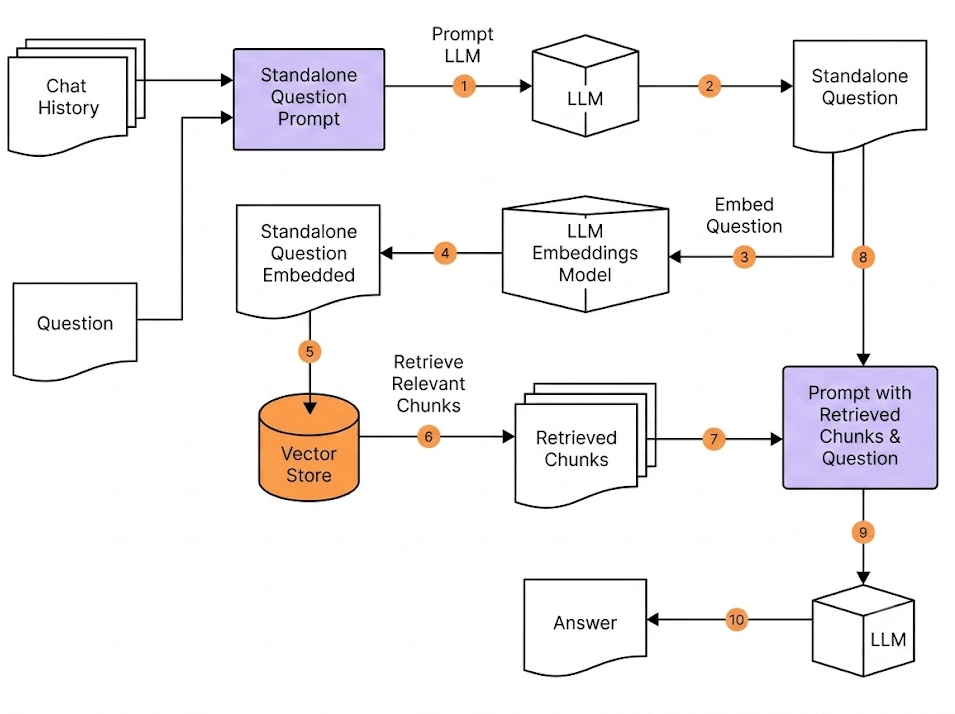
RAG (Research Aggregate Arrangement) is defined as an architecture that allows the model to obtain the information it needs from external data sources during inference, instead of retraining it. In RAG architecture, documents are first broken down into smaller pieces (chunking), and then each piece is converted into embedding vectors and stored in a Vector Database. When a user request arrives, the model finds the most relevant content based on semantic similarity instead of searching for keywords. Thus, the model can produce accurate and up-to-date outputs even on information that is not in its own parameters or that has become outdated. Therefore, RAG architecture is often preferred over retraining the model in enterprise applications that require up-to-date information. In RAG architecture, the information generation process consists of two stages. In the first stage, the user request is analyzed, and the documents related to the request are identified. In the second stage, the obtained information is sent to the model along with the request, and the model performs inferences only from this context. This approach does not update the model’s own knowledge; it only enriches the context it uses during inference. Thus, the answers produced by the model are based not only on probability calculations but also on verifiable information obtained from reliable sources. This approach is also referred to as Grounding. In this process, the accuracy, currency, and reliability of the data source used can be more crucial than model performance. An incomplete, erroneous, or poorly structured knowledge base can cause even the most advanced Large Language Model to produce incorrect results. Therefore, in RAG architectures, data governance, indexing strategy, and document lifecycle management are at least as important as model selection. However, RAG only provides information to the model. For real-world operations to be possible, the model must also be able to interact securely with external systems.
Large Language Models, by their default structure, cannot directly communicate with external systems. They cannot connect to a database, make an API call, access a file system, or perform operations on the operating system. The model only generates inferences within the context provided to it. This limitation is overcome by the Function Calling mechanism. Function Calling allows the model to determine that an external operation needs to be performed and to notify the application of this operation through a defined interface. Some manufacturers call this approach Tool Calling, and its basic working principle is the same as Function Calling. The execution of the operation is performed by the application, not the model. The Function Calling approach transforms Large Language Models from mere content-generating systems into decision support components that can be integrated into business processes. Today, many enterprise generative AI applications communicate with dozens of different services through this mechanism. This interaction with external systems also brings new security requirements. Because the model no longer only generates text, it can also indirectly make decisions that can initiate operations on real systems. Every operation request generated by the model must be verified, authorized, and logged. Otherwise, misdirected or malicious requests can cause unwanted operations to be performed on critical systems through the model. The development of the Function Calling mechanism has enabled Large Language Models to transform from single-step operations into structures that can plan and manage sequential tasks. This approach forms the basis of systems currently called Agentic AI. The ability to use multiple tools together allows models to evolve into systems that not only respond but also plan tasks.
The working principle in Agentic AI architectures consists of the following basic steps:
- The user defines the objective.
- The model breaks down the task into sub-steps.
- The necessary tools or services are identified for each step.
- The results obtained from the tools are evaluated.
- The process is repeated until the objective is completed.
- The final output is presented to the user.
This approach significantly expands the capabilities of the LLM. The model is no longer just a question-answering system; it functions as a coordination layer that plans and selects appropriate tools towards a specific goal. Instead of generating a single answer, the model requires the sequential execution of multiple processes. The model can plan steps such as accessing the data source, performing analysis, preparing reports, and using email services. However, these processes are not carried out by the model itself, but by authorized applications and services. In enterprise structures, Agentic AI is used for the automation of business processes. Many processes, such as classifying help desk requests, analyzing security incidents, supporting software development processes, document management, and reporting, can be built upon this architecture. Therefore, Agentic AI represents not a single model, but an orchestration structure where the LLM, Function Calling, RAG, and external services work together. While steps are predefined in classic workflows, in Agentic AI architectures, the model can plan the necessary steps to achieve the goal at runtime. In enterprise applications, instead of fully autonomous execution of critical processes, the Human-in-the-Loop approach is preferred, where the processes suggested by the model are submitted for human approval at certain stages. As the number of devices increases, the need for a common standard for communication between these devices has emerged.
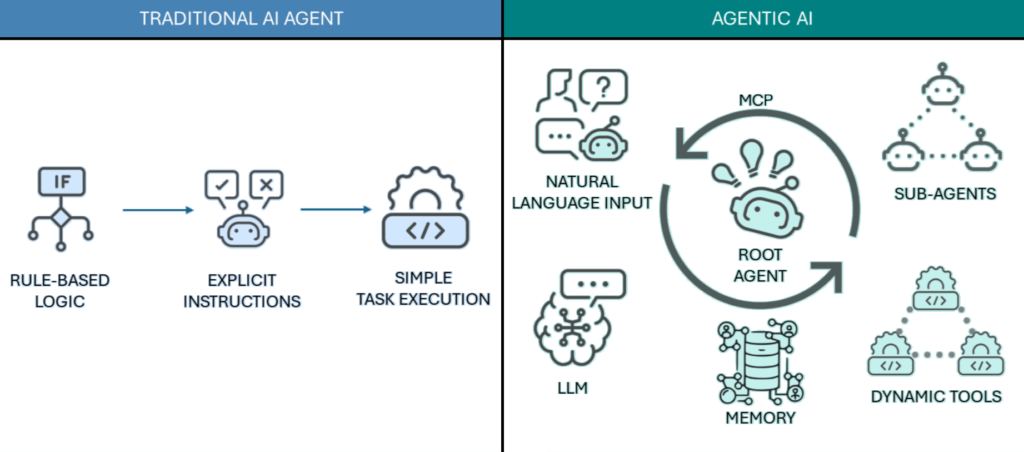
A need for a common and standardized communication method between different applications has arisen with the proliferation of Agentic AI systems. Developing separate integrations for Git repositories, databases, calendar applications, messaging platforms, and many different services has created a structure that is difficult to manage and unsustainable over time. Model Context Protocol (MCP) is defined as an open communication protocol developed to standardize this integration problem, enabling communication with external data sources and tools through a standard interface. The MCP architecture has three main components: MCP Host, which represents the LLM application with which the user interacts; MCP Client, which manages communication between the model and external services; and MCP Server, which makes external resources such as file systems, databases, Git repositories, or enterprise applications accessible through a standard interface. Thanks to this architecture, the model does not need to know how external systems work. The tools that can be used, the data sources that can be accessed, and the supported operations are defined by the MCP Server. The model only selects the resource it needs and requests the relevant operation. Thus, a significant portion of the application-specific integration can be managed through a standard protocol. MCP is not a technology that replaces the Function Calling mechanism. Function Calling enables the model to perform and request a specific operation. MCP, on the other hand, aims to enable these operations to be performed using a common standard across different data sources and applications. Therefore, many Agentic AI architectures today use Function Calling and MCP together. Similarly, just as HTTP allows different systems to communicate using a common language, MCP aims to create a similar standard between artificial intelligence systems and tools. New generation models developed in recent years support the Reasoning Model approach, which not only predicts the next token but also plans multi-step problems, generates intermediate inferences, and produces more successful results in complex tasks. These models do not learn new information; they can evaluate existing information in a more planned and systematic way, thus producing more successful results, especially in multi-step problems. This ability stems not from the model generating new information, but from its ability to evaluate existing information more systematically. Communication with external systems alone is not sufficient. The model must also be able to decide which tool to use and when.
As the capabilities of the model expand, the security approach must be evaluated to encompass not only the model but also all the components with which the model interacts. Classical information security approaches focus on protecting the application, database, and network layers. In LLM-based systems, however, prompts, context, information sources, tools, agents, and model outputs also become part of the attack surface. The security approach must now encompass not only the model but also the source of the data reaching the model, the tools the model uses, and how the output it produces will be used. Therefore, security requires not only protecting the infrastructure but also securing the model’s decision-making process. At this point, the concepts of AI Safety and AI Security differ. AI Safety aims for the model to behave safely, while AI Security aims to provide protection against attacks targeting the model and its surrounding architecture. As the model’s ability to make decisions and interact with external systems increases, security becomes an integral part of the decision-making process, not just the infrastructure.
LLM security is generally evaluated under four main headings:
- Model security
- Data security
- Application security
- User security
Model security aims to prevent the model from exhibiting unexpected behavior or being used for purposes other than its intended use. Data security encompasses the confidentiality, integrity, and accuracy of the information provided to and generated by the model. Application security aims to ensure the secure operation of components such as RAG, Function Calling, MCP, and Agentic AI, while user security focuses on reducing the risks of the model misleading, leaking information, or generating malicious content. LLM security is not solely the responsibility of the model provider. Examples of security measures include Prompt Injection, Indirect Prompt Injection, Sensitive Information Disclosure, and Excessive Agency.

Prompt injection is one of the most common attack methods targeting Large Language Models (LLMs). The attacker aims to alter the model’s expected behavior through direct prompts or indirectly transmitted content. The goal is to disable system-defined rules, redirect the model, or enable it to access information it wouldn’t normally be able to access. While user input is treated as data in classical applications, in Large Language Models, the same input can be transformed into a command interpreted by the model. This creates a new attack surface unique to LLMs, due to the fact that natural language can carry both data and instructions. Prompt injection attacks are generally carried out in two different ways:
- Direct Prompt Injection: The attacker sends the malicious prompt directly to the model. The user might request the model to ignore system rules, reveal hidden prompts, or disable specific security controls.
- Indirect Prompt Injection: The prompt is not sent directly by the user, but through external content accessed by the model. For example, prompts might be hidden within a webpage, PDF file, or corporate document analyzed by the model. When the model treats this content as reliable data, it can also interpret the attacker’s prompts as part of the process.
Prompt injection doesn’t just cause incorrect responses. The impact of the attack can be much greater in systems using function calling, RAG (Remote Access Grouping), or agentic AI. In scenarios where the model has the authority to use external tools, it can make incorrect API calls, transfer sensitive data to unwanted systems, initiate incorrect processes, or manipulate critical workflows. Therefore, prompt injection shouldn’t be considered solely a model problem. The real risk is the security of the systems the model can access. As the model’s authority increases, the impact of a successful prompt injection attack increases proportionally.
Jailbreaking targets the model’s natural language interpretation mechanism. The attacker attempts to modify the instructions given to the model, disregard security rules, or direct the model to produce unexpected behavior. In LLM applications that can access external tools, such attacks can lead not only to incorrect output but also to the initiation of unauthorized operations on critical systems.
Data security risks relate to the confidentiality of information transmitted to or generated by the model. Sharing sensitive corporate data within the system, including personal data in model outputs, misconfiguring access permissions, or storing conversation recordings without control are major risks that can lead to data leakage.
Attacks targeting information integrity aim to make inferences based on incorrect or manipulated information. In particular, in RAG architectures, modifying documents, adding fake content to the knowledge base, or including low-quality data in the system can directly affect the accuracy of the results produced by the model.
Tool and integration security has gained importance with the widespread adoption of Function Calling, MCP, and Agentic AI architectures. Excessive privileges granted to services accessible by the model, inadequate authentication mechanisms, or the direct processing of unverified model outputs can create opportunities for attackers to gain access to corporate systems via LLMs.
Model reliability, however, is a separate but directly related issue to security. Large Language Models can generate false information (hallucinations), misinterpret requests, or produce different outputs from the same input. Therefore, LLM outputs should not be accepted as directly true, especially in critical areas such as legal, financial, healthcare, or cybersecurity; they should be supported by appropriate validation mechanisms.
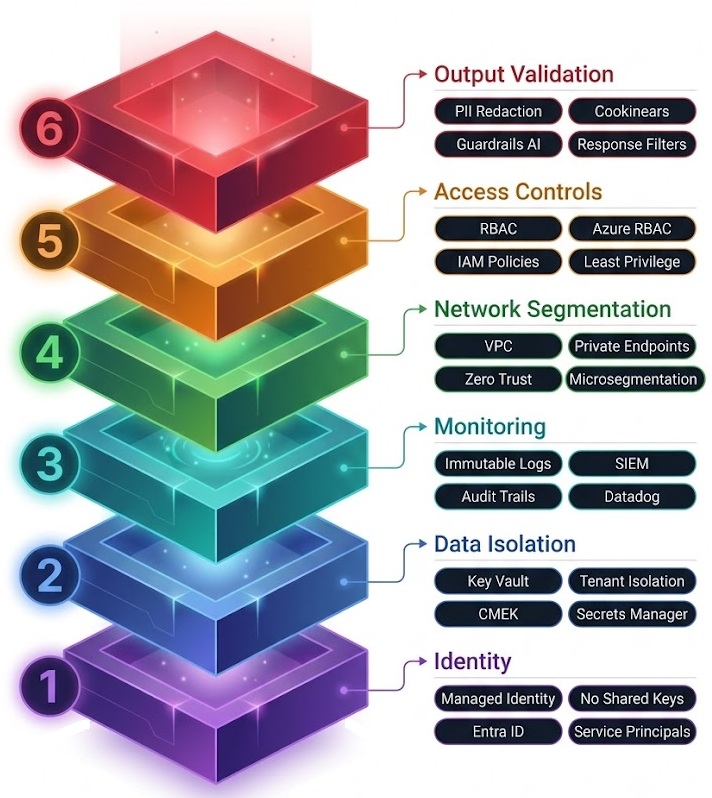
The common feature of these risks is that they cannot be eliminated simply by changing the model. A secure LLM application is created by implementing a combination of correct request design, controlled data access, the principle of least privilege, output validation mechanisms, user authorization, and continuous monitoring processes. In enterprise environments, the first issue to be considered is which data will be sent to the model. Sensitive information such as trade secrets, personal data, identity information, access keys, certificates, source codes, and corporate policies should not be transferred to the model without data classification. Especially in general-purpose cloud-based LLM services, using corporate data without reviewing data processing policies and storage conditions poses significant security risks.
Raising user awareness about the capabilities and limitations of the LLM, instilling the habit of preparing correct requests, and raising awareness about the protection of sensitive data are also important security layers as crucial as technical measures. The data sources and tools that the model can access should be restricted according to the principle of least privilege. Access to systems that an LLM does not need should not be granted, and critical operations should not be automatically performed with a single request. In particular, processes such as payments, data deletion, user creation, or authorization changes should be protected with additional validation mechanisms. Outputs generated by LLMs should not be considered reliable information. The model may produce content that appears technically correct but does not reflect reality. Therefore, instead of basing critical decisions directly on model output, it is recommended that they be supported by validation processes and human approval. LLMs should be positioned as decision support systems, not decision-makers. Especially in high-risk areas such as finance, healthcare, law, and cybersecurity, model outputs must undergo independent validation processes. In enterprise applications, requests, model outputs, and performed transactions should be logged. Log records, audit trails, and traceability mechanisms are essential for investigating security incidents, analyzing errors, and meeting legal requirements. The model lifecycle should also be considered within the scope of security. Model versions, integration components, and third-party libraries used should be updated regularly; new vulnerabilities and security recommendations published by the manufacturer should be monitored. Since the LLM ecosystem is evolving rapidly, the security approach should be treated not as static, but as a continuously improving process.
Achieving high efficiency from large language models isn’t possible simply by having access to a robust model. Successful results are directly related to understanding how the model works, preparing the correct context, and critically evaluating the generated output. Today, the primary goal of a good Prompt Engineer isn’t to prepare long and complex prompts. The real objective is to accurately define the problem, provide the model with all the necessary information, eliminate unnecessary details, and place the model in a context where it can make the right decision. In other words, good results are often obtained not from asking better questions, but from providing the model with more accurate information. When working with generative AI systems, instead of expecting perfect results in one go, it’s a more appropriate approach to treat the model as a teammate. First, analyzing the problem, identifying missing information, discussing alternative solutions, and then producing the final output significantly increases both accuracy and reliability. Therefore, experienced users prefer a multi-step process with AI rather than preparing single, lengthy prompts. Each answer produced by the model creates a new context, and each feedback improves the quality of the subsequent output.
One of the most significant shifts in generative AI in recent years has been the transition from Prompt Engineering to Context Engineering. Now, it’s not just about how the prompt is written, but also which documents the model can access, which tools it can use, which rules it is bound by, and which information it considers as context. A significant portion of successful AI applications in real life are able to produce reliable results not through impressive prompts, but through well-designed context management. However, Large Language Models should never be considered systems that produce absolute truths. Even the most advanced models can produce erroneous but convincing outputs due to incomplete context, outdated information, or ambiguous prompts. Especially in critical areas such as security, finance, healthcare, and law, model outputs should be validated with independent sources and used as part of the decision support process, not as a replacement for the decision-making mechanism. The greatest benefit from AI is obtained not by burdening it with more thinking, but by providing it with the right information, the right context, and the right target.
In the coming years, the determining factor for competitive advantage will not be simply being able to use the largest or newest model. The competence that will truly make the difference will be… The key is to accurately analyze the problem, manage reliable information sources, feed the model with appropriate tools, and critically evaluate the resulting outputs. When used correctly, generative artificial intelligence systems should not be positioned as a technology that replaces humans, but rather as a new generation of work partners that strengthen learning, analysis, production, and decision-making processes.
