
DWDM is an advanced multiplexing technology used in fiber optic communication. This technology enables the simultaneous transmission of multiple data streams of different wavelengths over a single fiber optic cable. Thus, the total data transmission capacity increases. Transmitting more information over a single cable is crucial in terms of both cost and practicality. DWDM systems are always connected to each other over a single-mode fiber optic cable.
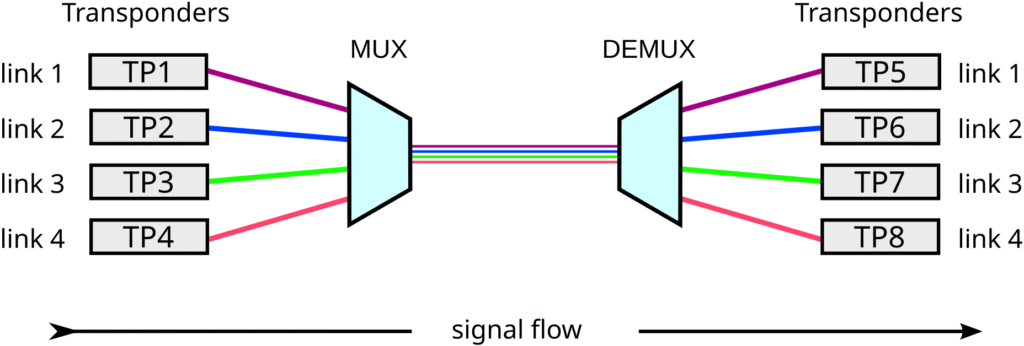
In the DWDM method, each data set passes over a different wavelength. Each wavelength works as an independent data channel and can support between 80 and 160 different channels. Due to the different wavelengths used in transmission, different data passing through the same cable do not affect each other. Therefore, there is no disruption or confusion during transmission. FM radio frequencies can be given as an example for the working principle of the DWDM system.
Thanks to DWDM technology, lines can be used at higher capacity, and more data can be carried very quickly over a single fiber cable pair.

Fiber Patch Panel and DWDM systems are two optical components that are similar in appearance but have different functions. Fiber Patch Panel is connected via single-mode or multi-mode cables, depending on the distances it will be used and transmits all signals in the same way, regardless of wavelength. While providing connection with connectors such as SC/LC/FC, DWDM devices use special modules such as mux/demux, transponder, and amplifier. Fiber Patch Panel is preferred for cable arrangement, management, and easy maintenance, while DWDM is preferred for transmitting multiple channels from a single fiber and establishing long-distance optical networks. While a Fiber Patch Panel has no distance-based effect on communications, DWDM plays an active role in long distances.
In DWDM systems, each data stream is modulated to a different wavelength and acts as an independent channel. The modulated signals are combined into a single optical fiber at the source point output, resulting in a single combined optical signal consisting of multiple wavelengths. When this combined signal reaches the receiving end via the fiber, it is decomposed again into its different wavelengths. Each wavelength corresponds to its own data signal as it was at the initial moment. These signals are then demodulated, i.e., the optical signals are converted to electrical signals, and the original data sets are recreated. The recreated data is transmitted to the relevant devices.

DWDM is divided into C-band (1530 nm – 1565 nm) and L-band (1565 nm to 1625 nm) in terms of wavelength. Wavelength spacing refers to the distance between adjacent wavelengths within the band. DWDM systems generally use closely spaced wavelengths such as 0.4 nm, 0.8 nm, and 1.6 nm. These values determine the distance between adjacent light signals and allow more data channels to be carried over the fiber. High bandwidth and high capacity optical fiber transmission is achieved in this way.
Additionally, DWDM systems are usually amplified with EDFA (Erbium Doped Fiber Amplifier) to minimize signal/data loss in long-distance transmission, and it is critical for intercontinental communication. EDFA is a type of fiber optic amplifier that directly amplifies weakened optical signals optically without converting them into electricity. It consists of a special fiber enriched with the element “Erbium” (Er) and generally operates at C-band wavelengths.
CWDM (Coarse Wavelength Division Multiplexing) similarly carries multiple signals on a single fiber, but does so using a wider range of wavelengths. The total number of channels varies between 8 and 18, while a 20nm wavelength is used. EDFA is generally not preferred because CWDM can operate outside the C-band. For this reason, it is not preferred for long-distance operations.
