
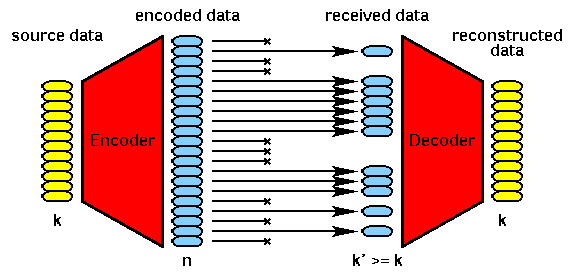
Forward Error Correction is used in telecommunications to check for errors that occur in unreliable or noisy communication channels. These are the control bits that are added to the packets in the data stream in order to correct the errors that occur during transmission in digital transformations by the target device after they are sent from the source device. After the transmitted messages reach the receiver, it is ensured that a limited number of errors that may occur in any part of the message can be detected by the receiver via FEC. This often prevents transmission of errors before they occur again and allows errors to be corrected during transmission. Thus, FEC has not only an error detection algorithm but also an algorithmic structure that helps to correct encountered errors.
The control bit/control packet ratio in the sent packets can be increased or decreased for the FEC used as the control mechanism. In order to do this, one of the determined FEC rates is selected. The FEC rate gives information about the control bit and the original bit values.
- 1/2: One of every two bits sent is the original bit and the other is the control bit.
- 5/6: Five out of every six bits sent means the original bit and the other means the control bit.
In this case, it can be interpreted that a higher quality data transfer is always performed in communication with a low FEC value. A low FEC value decreases the bandwidth, while a high FEC value increases the bandwidth. Each FEC tag to be added to the transmitted packets requires the use of high bandwidth. For this reason, FEC is often used in situations where retransmission is costly, error-free transmission is not possible, or data transmission is to be made simultaneously from the source to too many receivers.
Antenna diameters may increase in data transmissions with high FEC values. Bandwidth is one of the most important criteria that determine the quality of communication and the price of the service received in satellite communication systems. For this reason, low bandwidth and high speed are generally preferred for good communication in satellite systems. Speed is very important to communication systems in general. As the frequency range used is increased, the amount of information that can be carried in one second can also be increased.
FEC does not use a handshake algorithm like the method used in TCP for communication between source and destination. In communications where the source sends data to more than one receiver and the receiver receives data from only one source, each packet is sent twice as the simplest implementation method. The receiver checks both instances of packets forwarded to it, adhering to the protocols used. If compatibility occurs for both packets, the transmission is accepted. If there is no compatibility between the two packages, the package will be rejected and an attempt may be made to fill its place with a similar or empty package.

Information to be transmitted in satellite communication systems is sent in pulses. Different methods and modulation techniques have been developed for the transmission rate of information. Modulation, on the other hand, provides analog-digital conversion and transmission of the data to be transmitted via a carrier analog signal. It was originally intended for broadcasts via antenna, but today it is used in all wired and wireless communications. Thanks to modulation, audio or video data can be transmitted easily. The modulation technique used also affects the bandwidth.
Symbol Rate is the number of symbol changes, waveform changes, or signal events per second of a digitally modulated signal throughout the transmission medium. Its unit is expressed as symbols per second (baud).
We see FEC and Symbol Rate values side by side in satellite channel frequency lists. E.g; 6666 – 5/6 for ATV, 4444 – 5/6 for Show TV, TRT 30000 – 5/6. The first one of these values is Symbol Rate, and the second is the FEC value.
