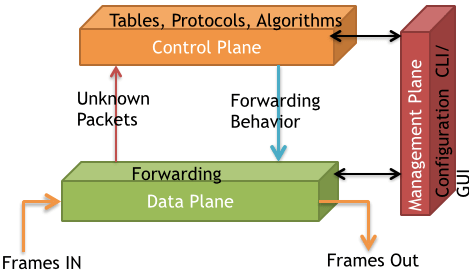
The network work architecture is similar to an operating system in its working structure. For this reason, network devices use router architecture to provide transmission. Plane concepts within the network are abstract concepts of where certain processes take place. At this stage, there are three most commonly used basic planes. Data Plane, Control Plane, and Management Plane.

Management Plane
It is the plane where the router components are used to manage network devices compatible with standard protocols. The management and forwarding rules of the network devices are implemented within the Management Plane. The configuration of network devices is performed with operations regarding. The Management Plane is required for all standard protocols such as REST API, SNMP, TELNET, SSH, NETCONF, GUI, etc.
Control Plane
The making and implementation of relevant decisions on the network are provided in the Control Plane. However, the Control Plane is not only responsible for the transmission decision of the packet, as in traditional network systems. It also provides an overview of the network, enabling other decision-making on the network to be performed. Thus, signaling between branches is provided and facilitates the topology creation phase.
In Routing, the Control Plane is the decision-maker for all operations that determine how the data packet or packet header is transmitted and which path to use for communication. It also allows controlling how data is transmitted from one point to another.
The control plane is responsible for populating the routing table, drawing the network topology, forwarding the table, and therefore deciding all operations be performed on the Data Plane. For this reason, the process of creating a routing table is considered part of the Control Plane.
Routers use various protocols to define routes in forwarding and store these routes in routing tables. In other words, the information from whom a packet coming from a neighboring device came and to whom it will go is checked. With software called routing software, it is decided what the address to be sent and the next data will be by looking at the routing table. This routing software can be routing protocols based on different metrics (OSPF, RIP, EIGRP, LDP, IS-IS, etc.).
Data Plane
The Data Plane is the plane where the actions are taken for the transmission to take place. Unlike the Control Plane, which determines how packets will be forwarded, packet forwarding operations are performed on the Data Plane based on the information received from the Control Plane. The data plane is also called the Forwarding Plane.
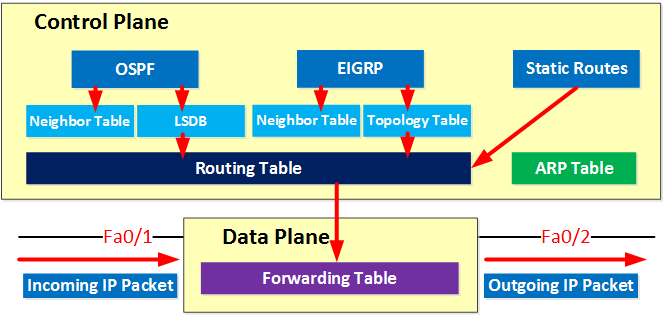
Data Plane refers to all the functions and processes that enable packet transmission, that is, the transport of packets or packet headers from one interface of the network device to another in packet transmission. The routing table, forwarding table, and routing logic form the function of the Data Plane. The communication that takes place within the Data Plane is made according to the decisions made on the Control Plane. In this case, the Data Plane is only responsible for moving packets from source to destination.
At this stage, it is the hardware components that provide the transmission. In the case of network devices, it constitutes the routing table, transmission techniques (Fast Switching, Process Switching, CEF Switching), MAC Address Table, routing logic, Data Plane function.
NOTE
Control Plane and Data Plane exist together. So software and hardware go hand in hand within network devices. The presence of two different architectural structures in the same place allows them to act as a single architectural structure.
In this case, the Control Plane is the software part of this architecture in terms of the decisions it makes and the tables it records. In line with the decision taken by this software, packet transmission is performed on the Data Plane. It is the devices, that is, the hardware, that performs this operation.
However, certain problems may arise at this point. If the module needs to be changed due to an error on a module in the device, all devices with the same error in the same network must go to the module change one by one. The problem that will arise will cause losses such as loss of time, loss of cost, loss of data, and loss of prestige. Thus, instead of dealing with all the devices that may cause the problem, the whole system can be fixed with a code to be written from a single point. At this stage, the Control Plane and the Data Plane must be separated from each other. Thus, the SDN structure emerges.