
QoS is the services that will be applied to traffic in order to provide efficient, sufficient, and quality service in telecom and internet communication. It is aimed to minimize error rates and increase network performance by reaching maximum bandwidth with the use of QoS in networks where guaranteed transmission is required. Network performance is a very important factor for both users and service providers.
QoS is a Layer 3 feature. It ensures business continuity of critical applications, no packet loss, and transmission in an acceptable time. QoS can be applied to all packets in data traffic. QoS mechanisms include certain services and applications that are needed, such as determining different priority levels to the packets, tagging the desired packets, and regulating the bandwidth.
QoS is also used to facilitate the control and management of UDP packets. Some of the applications running on the network are sensitive to latency. These applications usually use UDP communication instead of TCP. For packets transmitted with UDP, there is no control mechanism for successful transmission, so there is no ability to detect network congestion. Undelivered packets cannot be detected and retransmitted. In addition, packets should not be forwarded to the receiver, and the delay between transmitted packets should be at acceptable levels. Such losses cause negative consequences such as interruption, freezing, or synchronization in communication. In addition, to live audio and video communications, which are sensitive to packet losses, it is also important for IoT (Internet of Things), as smart devices.
The main causes of quality problems experienced in transmission are related to lack of bandwidth, delays, and packet losses. Heavy data traffic or congestion occurs when the packets coming to the forwarding router are waiting in the queue. On the “Buffer”, which is responsible for organizing the queued packets, if the current queue is full, packet loss occurs before the packets can enter the queue.

In order to prevent packet losses, the connection speed can be increased and QoS mechanisms can be applied. If certain packets can be prioritized via QoS, packets are transmitted without delay. While transmitting high priority packets, low priority packets may be lost and this can be ignored. In order to prevent packet losses, Channel Access Protocols or Random Access Protocols have been developed in Layer 2. Thus, the negative effects experienced can be prevented.
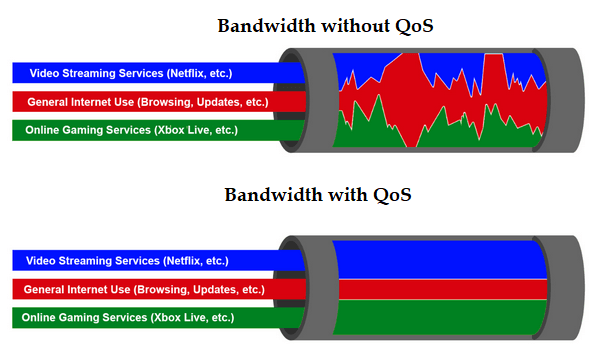
The bandwidth used in communication is equal to the minimum bandwidth capacity. Data traffic congestion occurs when the maximum capacity of the lowest bandwidth connection is exceeded. The solution to such problems is to increase the bandwidth capacity used in communication. However, this may not always be possible due to budget or technological constraints. QoS mechanisms are implemented to prioritize, control, flag, and queue traffic based on severity. Thus, priority applications should have sufficient bandwidth and the remaining bandwidth should be allocated to the least important traffic. After the operations to be applied are determined, the data carried in the traffic must be defined. For this reason, first of all, the packages should be classified in order to prioritize the packages in the traffic. In the next step, it should be marked according to the bits in the IP packet headers or Ethernet Frame. Finally, it is queued and packet transmission is started. The important thing at this stage is to determine the operations to be applied in traffic in accordance with the problem experienced.
Some definitions for QoS are prepared below;
- Delay: The time difference between the packets reaching the receiver, the delay.
- Jitter: Time difference between delays in packets, delay.
- Latency: The total time it takes for a packet to transmit from source to destination on the network, latency.
- Bandwidth: The limit value of the traffic that can be carried by the network.
- CIR: Committed Information Rate, that is, the committed data rate.
- PIR: Peak Information Rate, ie the peak point for the speed in data transmission.
- CBR: Committed Burst Size, ie the guaranteed size of data packets to which you send or receive committed data. The applications and systems you use may need to handle data packets of different sizes. If you know the size (in bytes) of the data packets you use, you can adjust this value according to your needs and ensure that data packets up to that size are processed. If you are not familiar with this subject, you can leave 0 (zero) as the default. In this case, you will continue to use the allowed data packet sizes as the standard without any limitations or rules that will be processed automatically.
- MBR: Maximum Burst Size, ie the maximum packet size allowed to be processed.
- MTU: Maximum Transfer Unit, the maximum packet size of data that can be transferred.
Some fixed delays causing lag;
- Propagation or End-to-End Delay: The time it takes for a packet to travel from source to destination over a communication medium such as fiber optic cables or copper wires.
- Serialization Delay: The time it takes to place all bits of a packet on a link. It is a fixed value that depends on the connection speed. The higher the connection speed, the lower the latency.
- Processing Delay: The fixed time it takes for a network device to receive the packet from an input interface and place the packet in the output queue of the output interface.
There are three main QoS models defined by the Internet Engineering Task Force – IETF, Quality of Service, known as the Internet Engineering Association, to provide QoS services in a network. It differs in how each model delivers data and how the network handles packets at a particular service level. These; Best Effort, Integrated Services (IntServ), and Differentiated Services (DiffServ).
Best Effort (Best Effort –BE)
Best Effort is the model with the simplest working structure among the QoS models. It has a working structure where all packets have the same priority and packet forwarding cannot be guaranteed. It is used by default in Internet communications and does not implement any QoS mechanism, so there is no complexity associated with this QoS model. It does not allow private resource reservation or any other mechanism within the network. Therefore, it will not work very well for any application that comes up with real-time (Real-Time) traffic demands.
Applied when networks cannot be configured using QoS policies or when the infrastructure does not support QoS. This model should not be used if the network resources are insufficient to implement the QoS requirements. In these cases, the user experience can be negative if there is no other mechanism to use to manage communication with applications competing for resources.
Integrated Services (IntServ)
IntServ is a model that provides QoS service by reserving bandwidth along a certain path. The IntServ model was developed to provide warranty service in real-time applications. Applications are notified to the network to reserve the resources they need (such as bandwidth). IntServ works more efficiently in small domains where the number of streams and the size of the network is controlled.
Implementing IntServ requires the use of an IntServ-enabled router device. It uses Resource Reservation Protocol (RSVP) to allocate resources needed across the network for a given application and to ensure that no other IP traffic can use the reserved bandwidth.
According to this model, every router in the network has to implement IntServ, and every application that requires a transmission guarantee must make a reservation, including the endpoints running the applications. Once bandwidth is reserved for a particular application, it cannot be reassigned for another application. Thus, IntServ has limited scalability and high network resource consumption. This is the biggest disadvantage of IntServ. Because it doesn’t scale well on large networks that may have thousands or millions of streams due to the large number of RSVP streams that need to be maintained.
According to the operating structure, applications request resource reservations from the network, and network devices monitor the packet flow to ensure that network resources can accept packets. The routing devices between the sender and the receiver determine whether the reservation request made by the application can be accepted. Rejected reservation requests are notified to the buyer. Otherwise, the traffic must be routed to the receiver. Thus, in this model, the routers remember the characteristics of the traffic flow and also control it.
Differentiated Services (DiffServ)
DiffServ is a model developed to address the limitations of Best-Effort and IntServ models and provides QoS service by differentiating traffic. It has a highly scalable structure. Instead of trying to provide a higher quality service to a certain portion of the traffic, it tries to provide the best possible service based on the changing traffic flow. The DiffServ model is the most popular and widely used QoS model.
DiffServ is a QoS model in which network elements such as routers are configured to serve multiple traffic classes with different priorities. It is defined independently of the devices in the network and Hop-by-Hop behavior is used to apply techniques such as queuing and prioritization to the package. At this stage, DiffServ cannot be defined as an end-to-end QoS solution. There is no need for a reservation protocol in DiffServ, that is, there is no RSVP stream to be maintained at each transmission point. It tries to provide an improved quality of service in the current network environment by changing the traffic flow.
DiffServ, when IP traffic passes over a network, each of the network devices defines assigned classes to packets. Packets are flagged to provide information about the level of service required by the transmitting devices on the network, based on business requirements or priority. Thus, a different service level can be assigned to each class, and packages are served according to this class. Multiple service levels can be selected with DiffServ. Packets are assigned priorities using the Differentiated Services Code Point (DSCP) for classification. The DSCP contains the priority bits and is 6 bits in total, contained in the IP packet.
For instance, traffic including IP telephony, file transfer, voice, and video packets is very latency-sensitive, so it should always be handled with high priority over other applications’ traffic. Email packets, on the other hand, can withstand a great deal of delay and can be served with the Best-Effort model. In addition, non-critical packets (YouTube, Facebook) can be either highly restricted or completely blocked, except for important applications used in the network. Thus, DiffServ will reduce the latency in traffic containing high-importance packets.

Additionally, the network architecture used also affects how QoS is implemented. Because Diffserv is a distributed QoS service model, resource allocation is distributed among all routers, providing greater flexibility and efficiency in the routing process. It also has advantages such as easy configuration, operation, use, and maintenance.
DiffServ vs IntServ
While DiffServ is a model that provides QoS in the network by differentiating the traffic, IntServ is a model that establishes a virtual circuit in the network using the bandwidth reservation technique. Unlike IntServ, which remembers stateful information on routers, DiffServ does not require router points in the network to remember any flow-related state information. Also, in a dense network, separating transmission paths and remembering state information will require effort for the device. Thus, it will be practically difficult to implement IntServ on the network. Therefore, IntServ is suitable for smaller structured private networks, while DiffServ is more suitable for large structure and heavy traffic networks.
The two QoS models mentioned are not mutually exclusive, even complementary, and in some special cases, both models can be used simultaneously in a particular network (IntServ over DiffServ).
