
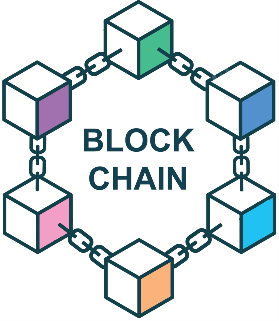
Blockchain is a decentralized, distributed digital ledger technology used to record and verify digital transactions. It can be considered a database that provides data and encrypted transaction tracking consisting of interconnected blocks. For example, each block contains information such as the recipient and sender information, the amount sent, and the date of a money transfer. Blockchain is a data structure in which data is grouped into blocks and these blocks are cryptographically linked to each other. Each block is linked to the previous block in a series and is recorded between nodes.
The roots of Blockchain technology date back to the late 1970s, when a computer scientist named Ralph Merkle patented Hash trees or Merkle trees. These trees represent a computer science structure for storing data by linking blocks together with encryption. In the late 1990s, Stuart Haber and W. Scott Stornetta developed a system in which document timestamps could not be tampered with using Merkle trees. This is the first application example in blockchain history. An anonymous person or group known as Satoshi Nakamoto defined blockchain technology in its current form with Bitcoin in 2008.
A blockchain network is a decentralized network where participants record and verify transactions on a distributed ledger. This network consists of a system where all participants participate equally and transactions are managed securely, without the need for a specific central authority. Data is divided into blocks that are chained with unique identifiers in the form of a cryptographic hash and shared with nodes within the network. The blockchain eliminates data duplication and increases security by providing data integrity through a single source of truth. Trust, responsibility, transparency, and security are inseparable elements of the chain. Since data cannot be changed without the joint decision of all parties, forgery and tampering with data are prevented in a blockchain system. The ledger kept for a blockchain can be shared but cannot be changed. Any attempt to change the data sends a warning to all participants and it is known which node made this attempt.
Traditional database technologies present many difficulties in terms of recording financial transactions. In traditionally implemented transfers, after money changes hands to complete a sale, the product is transferred to the buyer. Both the buyer and the seller can record monetary transactions individually, but it is not possible to fully trust both sources. The seller may claim that he did not receive the money even if he received it, and the buyer may claim that he paid the money even if he did not pay. In order to prevent possible legal problems, a trusted third party must audit and verify the transactions. The existence of this central authority not only complicates the transaction but also creates a security vulnerability concentrated at a single point. In such a case, if the security of the central database is compromised, both parties may be harmed.
Blockchain reduces these problems by creating a decentralized system where transactions can be recorded, resistant to external interventions. For a sales scenario, blockchain creates a common ledger for each buyer and seller. All transactions must be approved by both parties and are automatically updated in real-time in both ledgers. Any disruption in past transactions leads to the corruption of the entire ledger. The features of Blockchain technology have led to the use of this technology in various sectors and the emergence of digital currencies such as Bitcoin.
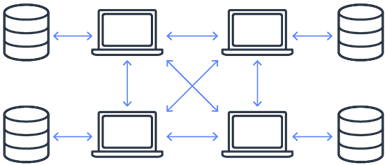
All devices or computers included in the Blockchain network are called nodes. According to its working structure, Blockchain is a shared ledger among all participants of the network without a central authority. Each participant, that is, a node, keeps a copy of the same distributed ledger, considered a connection point. All nodes that are assumed to be connected to each other in the network must agree on which blocks should be added to the ledger. There are two types of nodes. Full nodes keep the entire blockchain history and verify all transactions, while light nodes download and verify only the necessary transactions and blocks. Various consensus mechanisms are used for these transactions.
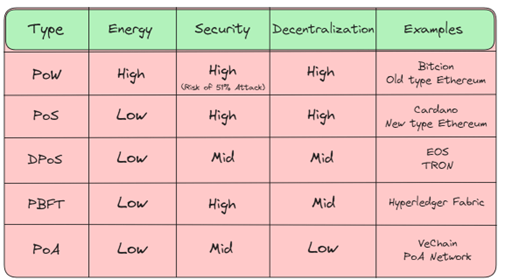
The consensus mechanism consists of a set of protocols and algorithms that allow all connection points in distributed networks to agree on the status of the network and new data added. These mechanisms ensure the accuracy and integrity of the blocks, eliminating the need for a central authority. All nodes are required to agree on a block, preventing unauthorized transactions, fraudulent transactions, or data manipulation on the network. Since the chain cannot be deleted or changed without consensus on the network, the data is chronologically consistent. Additionally, the consensus of each node allows transactions to be confirmed quickly and efficiently, ensuring the correct operation of the network even in the event of malicious or erroneous results on some nodes.
Commonly used consensus mechanisms include:
- Proof of Work (PoW)
- Proof of Stake (PoS)
- Delegated Proof of Stake (DPoS)
- Practical Byzantine Fault Tolerance (PBFT)
- Proof of Authority (PoA)
The applied transactions are collected over a certain period and form a block fragment. Each block contains the hash value of the previous block, which ensures that the blocks form an ordered and unchangeable chain. Digital signatures and asymmetric cryptography methods are widely used for hash functions. Thus, the security of the blocks is provided by cryptographic methods.
There is more than one type of blockchain. These are:
- Public Blockchain: A type of blockchain where everyone in the network can participate and make transactions. (Bitcoin, Ethereum)
- Private Blockchain: A type of blockchain where participation requires permission, usually controlled by a specific organization or group.
- Hybrid Blockchain: Hybrid blockchains are a type of blockchain that combines some features of both private and public networks. In this way, access to certain data stored in the blockchain is controlled, while the rest of the data is kept in common.
- Consortium Blockchain: A semi-private blockchain type controlled by more than one organization.
A blockchain transaction begins with the transfer of physical or digital assets from one party to another on the blockchain network. The block contains information such as the users who perform the transaction, the transaction order, transaction time, transaction location, the reason for the transaction, the total value of the asset, or prerequisites. Most participants in a distributed blockchain network must accept that the recorded transaction is valid. The acceptance rules may vary depending on the type of network but are usually determined when the network is established. After the participants reach a consensus, the transactions on the blockchain are written into blocks that are equivalent to the pages of a ledger. A cryptographic hash is added to the end of the new block along with the transactions. The hash acts as a chain that connects the blocks. If the content of the block is changed intentionally or accidentally, the hash value changes. This change provides a way to detect tampering with the data. In this way, the blocks and chains are securely connected to each other and cannot be rearranged later. Each added block increases the verification strength of the previous block and therefore the entire blockchain. Any possible intervention to past blocks disrupts the entire blockchain structure.

Blockchain technology has multiple advantages. The fact that there is no need for a central authority significantly increases the security and reliability of the system. All transactions are transparent and can be viewed and verified by everyone. It provides high-security thanks to cryptographic methods and distributed structure. Once the records are written, they cannot be changed or deleted. This protects data integrity. With Blockchain cloud services, transaction data from multiple sources can be easily collected, integrated, and shared.
Blockchain technology has both advantages and disadvantages. Continuous transactions cause a large amount of energy consumption due to ledger distributions and encryption. As the Blockchain structure grows, the processing of transactions can become slower and more costly. Integration with systems operating in a traditional structure today can be complex and costly. Legal regulations and uncertainties in different countries can make it difficult to adopt the Blockchain structure.
Blockchain technology continues to develop and grow as companies discover and implement new application areas. Traditional financial systems such as banks and stock exchanges use blockchain services to manage online payments, accounts, and stock market trading. However, the use of Blockchain technology is not limited to the financial sector. Energy companies use Blockchain technology to create peer-to-peer energy trading platforms and improve access to renewable energy. Companies in the media and entertainment sector use Blockchain technology to manage copyright data. Retail companies also use Blockchain to track goods movements between suppliers and buyers.
When we examine its working structure, advantages, and disadvantages, we see that a new world is waiting for us. As a result, Blockchain technology is used to create an unchangeable ledger to track orders, payments, accounts, and other transactions. Thanks to the Blockchain structure, more energy-efficient and scalable consensus algorithms are being developed. Governments and international organizations are working on regulations and standards that will facilitate the adoption of Blockchain technology, and intensive efforts are being made to expand the areas of Blockchain use in the software world in order to reveal its potential.
51% Attack is defined as an exploit that undermines the basic principle of decentralization, which is the advantage of Blockchain technology, and allows attackers to manipulate transactions. A 51% attack is defined as an attack on a blockchain network in which a single entity controls more than half (51%) of the stock or computing power. This disproportionate control is contrary to the decentralization principle of blockchain technology. This high control gives the power to rewrite transaction history, prevent transaction completion, and double-spend. It is important to note that a 51% attack is one of the most important security threats, especially for blockchains that use Proof-of-Work (PoW) and Delegated Proof-of-Stake (DPoW) consensus algorithms. The attacker can first perform a transaction and then rewind the blockchain to invalidate it. Thus, the attacker spends the same cryptocurrency twice. In addition, a 51% attack cannot exhibit the ability to create new assets, steal assets from unrelated parties, or change the functionality of block rewards.
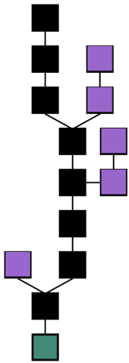
The first step involves the attacker accumulating more than half (51%) of the network’s computational or hashing power. By now controlling the majority of the network’s hashing power, the attacker effectively isolates their group from the main network while maintaining internal communication. Despite this separation, the attackers continue their mining operations but avoid sharing their progress with the primary network or receiving updates from it. As a result, the blockchain now begins to evolve independently with two parallel versions. Thanks to their superior hashing power, the attacker’s group can add blocks to their version of the blockchain faster than the rest of the network. Over time, the difference in length between the two versions of the chain becomes statistically proportional to the difference in hashing power between the two groups. When blocks of sufficient length are rejoined by the attackers, the two competing versions of the blockchain are propagated throughout the network. According to the rules of the consensus protocol, the longest blockchain data is kept on the nodes, and the shorter one is discarded. This means that all blocks added by the main network during the separation period are orphaned. After a successful process, a 51% attack allows threats that can significantly impact a blockchain network and its nodes. These threats range from financial fraud in the form of double spending to outright denial of service attacks that paralyze network functionality.
A 51% attack is not an easy task, requiring significant resources and time. Mining consumes a lot of energy. Bitcoin mining consumes up to 95.58 TWh of energy per year, equivalent to the annual energy consumption of Finland, a country with a population of over 5.5 million. Bitcoin whitepapers assume that it would be impossible to obtain 51% of Bitcoin, and therefore do not take into account the economic incentives behind a 51% attack. However, 51% of attacks against altcoins are feasible.
- In May 2018, a 51% attack occurred on Bitcoin Gold, which allowed the attacker to spend approximately $18 million worth of BTG twice. This incident caused significant damage to the coin’s reputation and market value.
- The most frequently targeted blockchain, Ethereum Classic, suffered a major attack in August 2020, where the attacker managed to double-spend $5.6 million worth of ETC.
- Vertcoin, lesser known compared to its peers, suffered a 51% attack in December 2018. The attacker managed to double-spend 603 VTC, equivalent to approximately $100,000.
